The Supreme Court appears ready to strike down President Trump’s executive order limiting birthright citizenship, with even conservative justices signaling skepticism about the administration’s constitutional reinterpretation during historic oral arguments where Trump attended in person.
Story Snapshot
- Supreme Court justices, including Trump appointees Roberts and Gorsuch, expressed doubt about the administration’s claim that the 14th Amendment excludes children of illegal immigrants from automatic citizenship
- President Trump made unprecedented history by attending oral arguments as a sitting president, highlighting the high stakes of his day-one executive order targeting birthright citizenship
- The case challenges over 125 years of legal precedent established by the 1898 Wong Kim Ark decision, which broadly affirmed birthright citizenship for children born on U.S. soil
- Conservative legal experts remain divided, with some defending Trump’s sovereignty-focused approach while others warn the order exceeds executive authority and contradicts constitutional text
Trump’s Executive Order Faces Constitutional Scrutiny
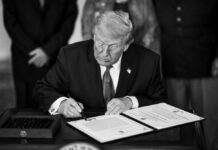
President Trump signed an executive order on January 20, 2026, his first day back in office, restricting automatic citizenship for children born in the United States to undocumented immigrants or temporary visitors. The administration argues these children do not fall under the 14th Amendment’s jurisdiction clause because their parents lack sufficient allegiance to the United States.
Solicitor General D. John Sauer presented this case before the Supreme Court on April 1, 2026, claiming the Citizenship Clause was intended solely for descendants of freed slaves, not for children of illegal aliens. The order, set to take effect 30 days after signing, immediately faced legal challenges from the ACLU and other civil rights organizations.
Justices Signal Skepticism Toward Administration Arguments
During oral arguments, conservative justices appointed by Trump himself delivered a frosty reception to the administration’s legal theory.
Chief Justice John Roberts and Justice Neil Gorsuch questioned whether the executive branch possessed authority to unilaterally reinterpret the 14th Amendment’s clear language that “all persons born or naturalized in the United States, and subject to the jurisdiction thereof, are citizens.”
Justice Brett Kavanaugh joined other justices in pressing Sauer on how the administration’s narrow reading squared with the 1898 Wong Kim Ark precedent, which affirmed birthright citizenship for children of legal resident aliens. The justices’ pointed questions suggested difficulty accepting that an executive order could override constitutional text and over a century of settled law.
Constitutional Text and Precedent at Center of Debate
The 14th Amendment’s Citizenship Clause, ratified in 1868 after the Civil War, established that all persons born on U.S. soil and subject to its jurisdiction automatically become citizens. Congress reaffirmed this principle in federal statutes passed in 1940 and 1952, codifying the common-law tradition of jus soli or birthright by soil.
The Supreme Court’s Wong Kim Ark decision in 1898 broadly interpreted this clause to include children of Chinese legal residents, establishing precedent that extended beyond freed slaves to encompass “all children here born of resident aliens.”
The administration attempted to distinguish this precedent by arguing it does not apply to children of illegal immigrants or temporary visitors, citing the narrower 1884 Elk v. Wilkins case that denied citizenship to Native Americans not under full U.S. jurisdiction.
Immigration Sovereignty Versus Constitutional Limits
The Trump administration defends the order as necessary to curb birth tourism and chain migration, arguing that national sovereignty permits the president to determine who deserves citizenship.
Mike Davis, writing for Fox News, urged the Court to restore what he called the “original understanding” of the 14th Amendment, distinguishing Wong Kim Ark as limited to legal residents rather than illegal entrants.
This perspective resonates with conservatives frustrated by decades of permissive immigration policies under previous administrations that incentivized illegal border crossings.
However, the case tests whether executive power can unilaterally redefine constitutional citizenship criteria without congressional action or constitutional amendment, raising concerns about government overreach that should trouble limited-government advocates regardless of policy goals.
ACLU National Legal Director Cecillia Wang argued the order represents an unlawful rewrite of the Constitution, asserting that even Congress lacks authority to deny citizenship to children born on U.S. soil.
Civil rights organizations warn the policy would create a permanent underclass of stateless individuals, undermining the equality principle embedded in the Citizenship Clause. The case remains pending before the Court, with legal experts predicting the justices will likely strike down Trump’s order based on the skepticism displayed during arguments.
A ruling against the administration would preserve constitutional limits on executive power while reinforcing precedent, though it would frustrate conservatives seeking immediate action on immigration enforcement and border security.
Sources:
Supreme Court appears skeptical of Trump’s case to end birthright citizenship – ABC News
Mike Davis: Sanity must be restored on birthright citizenship – Fox News
The key arguments in the birthright citizenship case – SCOTUSblog
Supreme Court hears Trump birthright citizenship executive order oral arguments – Democracy Docket
Birthright citizenship: Hard questions and the best answers for Trump’s challengers – SCOTUSblog