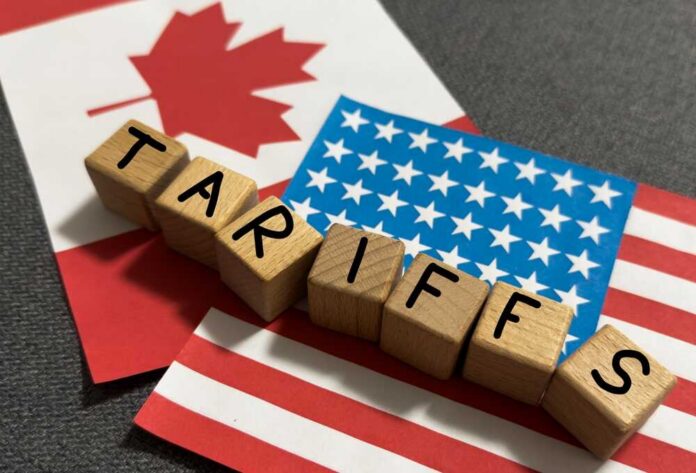
When a sitting president says foreign wildfire smoke should trigger 50% tariffs on cars, whiskey, and cheese, you know the trade fight has left the realm of normal politics and wandered into something new and dangerous.
Story Snapshot
- Trump links Canadian wildfire smoke to a sweeping 50% tariff hit on Canadian goods.
- He accuses Canada of “willful negligence” in forest management and demands they pay.
- Canadian leaders fire back with hard numbers on forest spending and mutual aid.
- Legal experts say there is no clear way to tariff wildfire smoke under U.S. law.
Trump turns wildfire smoke into a trade weapon
President Donald Trump did not just complain about smoky skies. He turned drifting wildfire smoke from Canada into a pretext for a new trade escalation, tied to already steep tariffs on Canadian goods. In a Truth Social post, he claimed the United States was being “unnecessarily invaded by filthy, polluted, and unhealthy air,” and called that invasion “willful negligence” by Canada.
He then argued that the “cost of this pollution” should be added to the tariffs Canada is paying on autos, alcohol, cheese, and more. The message was simple: if American lungs suffer, Canadian exporters pay.
Trump’s threat landed on top of an existing trade war structure. Since 2025, his administration has used national security emergencies under the International Emergency Economic Powers Act and Section 232 to slap double‑digit tariffs on most Canadian imports, raising Canada’s effective tariff rate to more than 8 percent.
By tying wildfire smoke to those measures, he folded an environmental crisis into a larger pattern: non‑trade disputes, from drugs to immigration and now air quality, were all being turned into tariff leverage against a close ally.
.@USTradeRep Ambassador Greer explains the tariffs on a set of Canadian imports: "They banned the sale of U.S. liquor and other booze on Canadian shelves. They capped and limited the amount of autos that could be shipped [from] the United States from companies who were reshoring… pic.twitter.com/cQrySGrv1L
— Rapid Response 47 (@RapidResponse47) July 21, 2026
Michigan Republicans push the “Canadian inaction” storyline
Trump did not stand alone. Four Republican members of Congress from Michigan sent a sharp letter to Canadian Prime Minister Mark Carney accusing Canada of failing in its duty to manage forests and prevent fires that push smoke into American cities.
They described hospitals treating children and dialysis patients for smoke that “did not originate anywhere near them” and said “American lungs are paying the price for Canadian inaction, year after year.”
They warned that U.S. agencies might explore “direct involvement” in cross‑border fuel reduction and firefighting if Canada did not change course. For those worried about sovereignty and security, that language hits a nerve.
Trump’s ambassador to Canada, Pete Hoekstra, reinforced the seriousness of the threat. He said he was “on the same page as the president” and that the administration was “seriously considering” tariff changes tied to smoke damage.
Hoekstra pointed to business closures and tourism losses in Michigan as economic proof that the smoke was not just an environmental nuisance but a real hit to American livelihoods.
On the surface, that lines up with a common‑sense view: if a neighbor’s decisions cost you money, you demand compensation. But the story gets more tangled when you look at what Canada has actually been doing.
Canada’s $12 billion rebuttal and the reality of a giant forest
Prime Minister Mark Carney did not answer with slogans. He answered with a number: 12 billion. He said Canada had invested 12 billion Canadian dollars since 2020 in forest sustainability and fire prevention through federal and provincial programs, indigenous‑led fire management, aircraft fleets, ground crews, and early detection systems.
Ontario Premier Doug Ford called Trump’s charge “ridiculous” and “a bunch of rubbish,” and reminded Americans that Canada has a long record of sending crews south to help fight U.S. fires. For Canada, the idea of “willful negligence” clashes with documented spending and years of mutual aid.
Experts raised a simple physical reality that cuts against Trump’s “not properly maintaining their forests” line. Canada’s boreal forest covers hundreds of millions of hectares, most of it remote and uninhabited. You cannot groom, thin, and patrol every acre of wilderness any more than you can patrol every wave in the Atlantic.
Scientists point to hotter, drier conditions and longer fire seasons as the main drivers of larger, more intense wildfires, not a sudden collapse in Canadian forest work. The key question becomes: are we blaming Canada for what is really a broader climate and land‑management challenge?
Can you tariff smoke, and who really pays?
The most practical problem in Trump’s threat is not emotional, it is legal. Trade lawyers say there is no clear mechanism in U.S. law to impose a tariff on a neighbor over air pollution from naturally occurring wildfires. Section 232 covers national security threats from specific goods. Balance of payments rules and other tools are built around products, not drifting smoke.
A recent Supreme Court ruling already narrowed Trump’s emergency tariff powers, making creative uses of national security claims harder to defend in court. You can shout “tariff the smoke,” but you still need a statute to hang it on.
TRUMP ANNOUNCES 50% TARIFFS ON BROAD RANGE OF CANADIAN GOODS
President Trump is escalating a trade fight with Canada. WWNN's Stacy Lyn reports:: “President Trump announced new 50% tariffs on a broad range of Canadian goods including wine, hockey equipment, furniture, clothing,…
— Worldwide News Network (@WorldwideNNX) July 21, 2026
There is also the pocketbook issue. When Trump floated 50 percent tariffs on a broad range of Canadian products, including autos, energy, and food, earlier fights showed who gets hit first. U.S. and Canadian analysts found that earlier Trump tariffs “hurt U.S. consumers most,” as higher duties on imports flowed through to prices in lumber yards, grocery stores, and gas stations.
A new layer of tariffs tied to wildfire smoke could raise costs on everything from Canadian cheese to Canadian car parts. That might feel like punishment for Canada, but it shows up as higher bills for American families and factories.
What this fight reveals about modern trade politics
Trump’s threat over wildfire smoke is not just a quirky headline. It shows how trade policy is now used as a catch‑all tool to express anger at almost any cross‑border problem. Fentanyl, migration, and now smoke all become reasons to raise tariffs.
That might match a gut‑level desire for toughness, but it blurs the line between serious national security threats and natural events that do not respect borders. When that line blurs, the risk grows that allies answer tariffs with their own, and regular people pay the price while politicians trade barbs.
The Canadian response, built on spending figures, mutual aid history, and basic forest science, undercuts the picture of a lazy neighbor shrugging while Americans cough. At the same time, American complaints about real economic harm from smoke are not made up; smoky summers do hurt tourism, small business, and health budgets.
Sources:
apnews.com, bbc.com, easternherald.com, youtube.com, en.thairath.co.th, facebook.com, congress.gov