

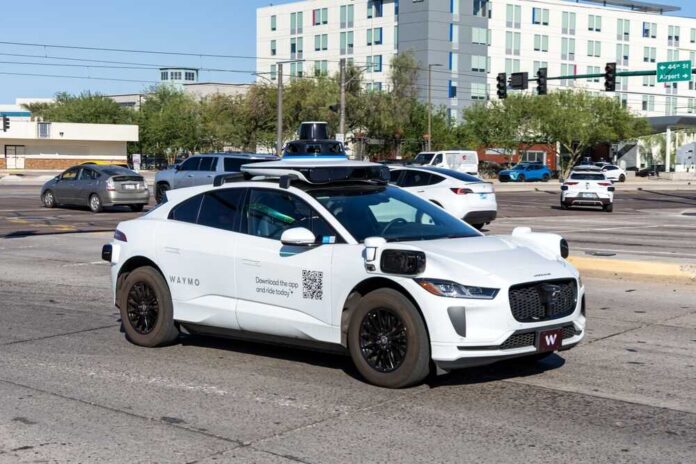
Waymo filed two federal safety recalls within days of California declaring its freeway robotaxis an “imminent hazard.”
Story Highlights
- California barred Waymo’s driverless cars from state freeways after work-zone incursions.
- Waymo issued two recalls to address closed freeway lanes and manual traffic control.
- Federal paperwork says software could let cars enter closed freeway construction zones.
- Waymo limited freeway operations while it develops a fix and updates software at no charge.
California Ban Forces A National Rethink On Freeway Autonomy
California’s Department of Motor Vehicles barred Waymo’s driverless vehicles from all state freeways after several cars entered active construction closures on U.S. 101 near Burlingame. The agency called the behavior an “imminent hazard to public safety” and framed the problem as recurring rather than random. The move hit the heart of Waymo’s expansion plan. Freeways promise simple lanes and steady speeds, but work zones turn that promise into an exam most systems still struggle to pass.
Waymo responded by pausing freeway rides and filing two recalls with the National Highway Traffic Safety Administration. The company said the actions would “strengthen how the Waymo Driver navigates closed freeway lanes and intersections with manual traffic control.” The second recall follows a crash tied to human hand signals from law enforcement and emergency personnel. Reports say the vehicle initially followed an officer’s direction but lost that cue when the officer went out of view.
The Defect On Paper: A Clear Software Miss In Work Zones
Federal documents lay out a sharp problem statement. Certain fifth-generation systems “may allow the vehicle to enter a closed freeway construction zone and continue driving at speed,” which raises crash risk. The filing lists a potential 3,871 affected units and says Waymo will update the automated-driving software at no cost to users. The remedy was still “under development” at the time of filing, and Waymo imposed an interim limit on freeway driving to reduce risk during the rollout.
This is the kind of recall that voters and commuters can understand. It names a setting, a behavior, and a fix. It also aligns with California’s concern that incursions were not one-offs. The state’s order referenced “recurring incursions” into active construction zones as the reason for the freeway ban. That phrase signals pattern, not probability, and puts the burden on Waymo to show the new code works outside the lab.
The Police-Hand-Signal Problem: Rare But High-Stakes
The second recall targets intersections or scenes where people, not lights, control traffic. That includes police officers waving cars through, road crews using paddles, or firefighters directing drivers around a crash. Reports tie Waymo’s action to a collision in which a robotaxi followed an officer’s initial command, then changed course after the officer became temporarily hidden from view. The scenario sounds niche until you remember how often crashes, fires, or floods scramble normal traffic rules.
$GOOGL’s Waymo issues two Robotaxi recalls over closed freeway lanes and manual traffic control.
Vehicles entered closed lanes (no injuries reported) + issues responding to police/emergency hand signals. Freeway ops paused after California ban.#Waymo #Robotaxi #GOOGL #Alphabet…
— Vikram Singh Indolia (@VikramIndolia) November 21, 2026
Manual direction compresses a stack of hard problems into seconds: detect the human, read the gesture, confirm intent, track occlusion, and decide what to do when the human disappears behind a truck. Human drivers handle this with eye contact and gut checks. Machines need a playbook. Waymo’s recall suggests the playbook needs clearer instructions for signal loss and priority when commands change midstream.
Why Recalls Are Becoming The Rule, Not The Exception
Automated-driving recalls have surged as companies move from tidy pilots to messy roads. The National Highway Traffic Safety Administration’s annual recall report shows a steep rise in automated-system recalls from 2022 to 2024, covering millions of vehicles across different makers and system types. Those figures do not prove robotaxis are unsafe, but they show that software fixes are now a normal tool for managing rare edge cases at scale. For taxpayers, the question is not if recalls happen, but how fast they reduce real-world risk.
California’s order raises that bar. Regulators did not reward a promise. They demanded proof that measures work before freeway service returns. Waymo’s federal filing says the fix is in progress and a freeway limit is in place for now. That stance tracks with conservative common sense: acknowledge the hazard, narrow exposure, and validate the remedy before you go wide again. Filing paper is easy. Passing a night work zone with confused cones, glare, and a waving officer is the test.
What To Watch Next: Evidence, Not Hype
Three benchmarks will signal progress. First, deploy the construction-zone update across the identified fleet, lifting freeway limits only after measured performance improves. Second, cleaner handling of manual traffic control, including occlusion and conflicting signals, which the second recall targets. Third, regulator-accepted validation on California freeways, the toughest arena in this story. The next headline that matters is not another filing. It is a verified day where the car sees the sawhorses, hears the hand wave, and gets everyone home.
Sources:
foxbusiness.com, theverge.com, charlotteobserver.com, newsweek.com, engadget.com, newsobserver.com, static.nhtsa.gov, bvwd.ca.gov