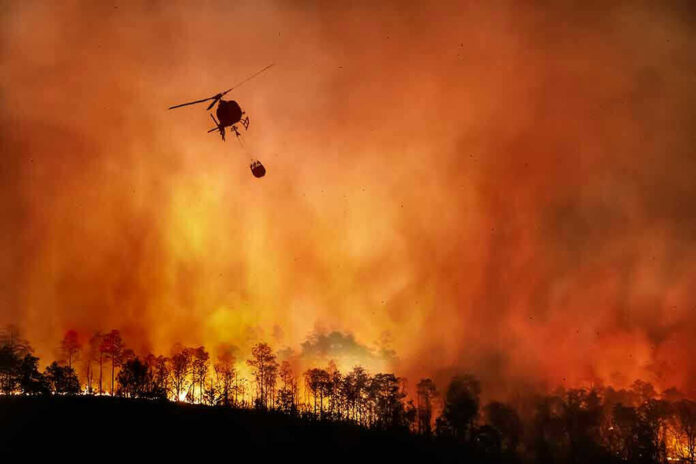
The iconic Grand Canyon Lodge on the North Rim, one of America’s most treasured pieces of history, now lies in ashes after being devoured by wildfire.
At a Glance
- The 1937 Grand Canyon Lodge, a National Historic Landmark, was destroyed by the Dragon Bravo Fire in July 2025
- Over 5,000 acres burned, with 50–80 structures—including the visitor center and employee housing—lost
- North Rim evacuated and closed for the remainder of the 2025 season; no injuries reported
- A chlorine gas leak from the ruined water treatment plant forced further evacuations
A National Treasure Lost—And For What?
July 2025 will go down as one of the darkest chapters in the story of America’s national parks. The Grand Canyon Lodge, an 88-year-old testament to American craftsmanship and grit, is gone—burned to the ground alongside dozens of other North Rim structures.
The Dragon Bravo Fire, which started as a so-called “controlled burn,” exploded out of control thanks to parched conditions, high winds, and what critics call a reckless disregard for basic common sense in fire prevention.
Fire crews scrambled as the blaze tore through more than 5,000 acres, leaving a trail of devastation in its wake. Between 50 and 80 buildings, including the visitor center, administrative offices, and employee residences, were lost.
The National Park Service evacuated the North Rim in a move that, at least, ensured no lives were lost. But the scars—physical, economic, and cultural—may never fully heal.
Failure of Policy, Failure of Priorities
The destruction of the Grand Canyon Lodge is not only a tragic loss for the millions who cherish America’s historic landmarks, but a brutal indictment of decades of forest mismanagement.
For years, federal and state agencies have prioritized every “critter and twig”—locking up land, suppressing logging, tying the hands of those who know how to responsibly manage forests.
The result? Choked, overgrown, tinderbox conditions where one spark—controlled or not—means disaster.
Fire management teams, hobbled by red tape and “environmental impact” studies, were forced to shift rapidly from so-called “prescribed burns” to full-blown suppression.
The Dragon Bravo Fire, whipped up by extreme heat and low humidity, proved more than a match for any late-game rescue effort.
As if the flames weren’t enough, a chlorine gas leak from the destroyed water treatment plant forced the evacuation of firefighters and hikers from the canyon’s depths.
The North Rim is now closed for the rest of 2025. The only thing open is a debate about how we got here—and who’s to blame.
Economic Fallout and a Wounded Community
With the North Rim shuttered until at least 2026, the local tourism economy is in free fall. The Grand Canyon Lodge was more than a rustic retreat; it was the beating heart of the North Rim’s entire summer season.
Park employees are displaced. Local businesses, already battered by inflation from years of government overspending, now face an endless off-season.
The ripple effect will be felt far beyond Arizona—across the national park system and the entire tourism industry, which relies on these historic sites to attract visitors from around the world.
Restoration will be slow, expensive, and—thanks to more bureaucracy—likely mired in never-ending studies and “stakeholder meetings.”
The real cost, though, is the loss of heritage. You can’t rebuild the past, no matter how many stimulus dollars you print or how many federal grants you throw at the problem. When history is gone, it’s gone.
Voices from the Fire: Experts Speak, Bureaucrats Blame
Fire officials point to “climate change” as the culprit, but anyone with common sense can see that decades of letting forests grow wild—while ignoring proven fire mitigation tactics—set the table for catastrophe.
Preservationists mourn the destruction of the Grand Canyon Lodge, calling it an irreplaceable blow to American heritage.
Environmental scientists admit that fuel buildup and drought created a powder keg, while tourism experts warn that North Rim visitation may never recover to pre-fire levels.
Politicians and bureaucrats, meanwhile, dodge hard questions and promise “reviews” and “new strategies.”
But the American people see through it. When the government forgets who it’s supposed to serve, we all pay the price—sometimes in dollars, sometimes in lost jobs, and sometimes in the ashes of our shared history.