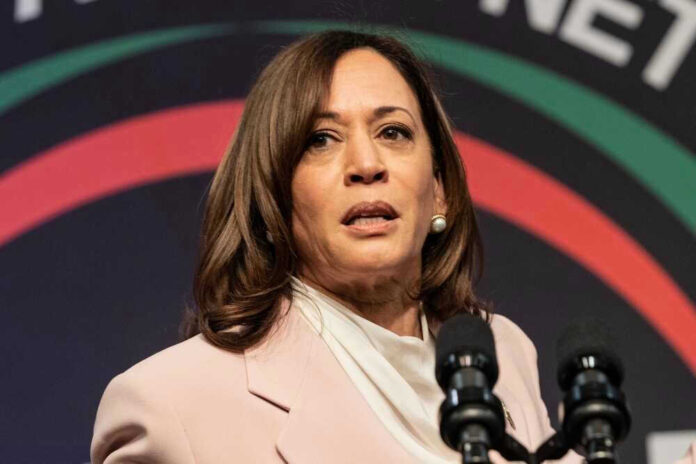
Kamala Harris admits in her new memoir that she rejected Pete Buttigieg as her running mate because America wasn’t ready for a ticket featuring both a Black woman and a gay man.
Story Overview
- Harris called Buttigieg “an ideal partner — if I were a straight white man” but deemed the combination “too big of a risk.”
- The decision reveals how identity politics drove strategic calculations in the 2024 Democrat campaign.
- Harris acknowledged America was “already asking a lot” to accept a Black woman married to a Jewish man.
- The revelation exposes the left’s own limitations on diversity when electoral power is at stake.
Harris’s Calculated Political Decision
In her forthcoming book “107 Days,” Kamala Harris provides a rare glimpse into the political calculations that drove her 2024 vice-presidential selection process.
She openly admits that Pete Buttigieg would have been her preferred choice, describing him as someone who would make “an ideal partner — if I were a straight white man.”
The candid admission reveals how Democrats, despite their rhetoric about inclusion and representation, ultimately bowed to perceived electoral risks when it mattered most.
Harris’s reasoning centered on what she called compounding political risks. She stated that America was “already asking a lot” to accept “a woman, a Black woman, a Black woman married to a Jewish man.”
Adding an openly gay running mate to this equation was deemed politically suicidal. Her exact words capture the dilemma: “Part of me wanted to say, Screw it, let’s just do it. But knowing what was at stake, it was too big of a risk.”
The Left’s Diversity Hypocrisy Exposed
This revelation exposes a fundamental contradiction within progressive politics. For years, Democrats have lectured Americans about embracing diversity and rejecting traditional electoral considerations based on race, gender, or sexual orientation.
Yet when faced with the ultimate test of their convictions, Harris and her team chose electoral pragmatism over their stated principles.
The decision demonstrates that even the most progressive politicians recognize there are limits to how much social change American voters will accept simultaneously.
The irony runs deeper when considering the Democrat Party’s constant accusations that Republicans are driven by prejudice and intolerance.
Here we have the party’s own nominee openly admitting she rejected a qualified candidate based purely on his sexual orientation and how it would interact with her race and gender.
This wasn’t about policy differences or governing philosophy—it was about identity politics calculations that the left typically condemns when attributed to conservative voters.
Buttigieg’s Political Ceiling Revealed
Pete Buttigieg has long been positioned as a rising star within Democrat circles, serving as Transportation Secretary and maintaining a close professional relationship with Harris.
His consideration for the vice-presidential slot seemed natural given his national profile and campaign experience from the 2020 Democrat primary.
However, Harris’s revelation suggests that Buttigieg may face permanent barriers to higher office due to factors completely outside his control or qualifications.
The decision also raises questions about the Democrat Party’s genuine commitment to LGBTQ+ representation in leadership positions.
While the party celebrates symbolic appointments and uses identity as a political weapon against Republicans, this episode suggests that when real power is at stake, traditional electoral considerations still dominate.
Buttigieg’s sexuality, which Democrats typically frame as irrelevant to governance, suddenly became the determining factor in his exclusion from national leadership.
Electoral Strategy Versus Progressive Ideals
Harris’s frank admission provides insight into the tension between progressive ideals and electoral reality that continues to plague the Democrat Party.
Her internal debate—wanting to “say, Screw it, let’s just do it” while ultimately choosing caution—reflects a party struggling to reconcile its activist base’s demands with broader American sentiment.
This pragmatic approach contradicts years of Democrat messaging that suggested opposition to diverse candidates was purely based on Republican prejudice.
The revelation also validates concerns many conservatives have raised about identity politics driving Democrat decision-making.
Harris explicitly framed her vice-presidential selection through the lens of demographic characteristics rather than governing philosophy or policy alignment.
Her calculation that America could only handle so much demographic change at once suggests that even progressive politicians understand there are limits to how quickly they can transform American political norms through representation alone.