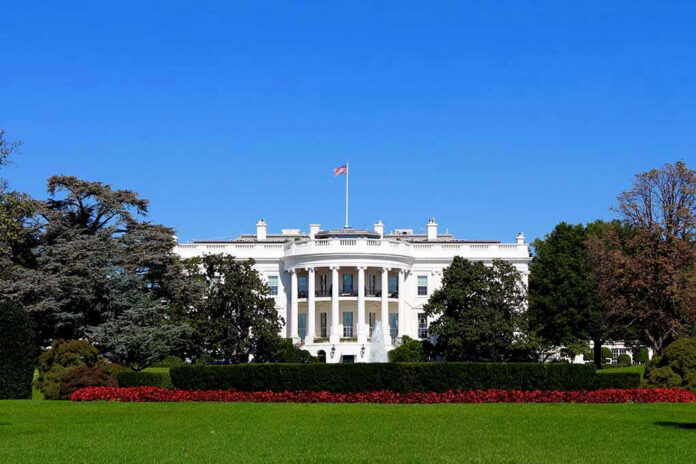
The White House is signaling a sharp break from the pandemic-era CDC by eyeing a uniformed public health officer—and that choice could reshape how Washington handles the next national health emergency.
Story Snapshot
- Dr. Erica Schwartz, a Coast Guard rear admiral and former deputy Surgeon General, is reported as the White House’s top pick to lead the CDC.
- The reporting is based on current and former officials; no formal nomination or public confirmation has been announced.
- Schwartz’s background blends military-style command experience with federal public health leadership from Trump’s first term.
- The development revives a core post-COVID question: should the CDC prioritize operational crisis response or academic epidemiology culture?
White House Signals a “Command-and-Operations” Direction for the CDC
Current and former officials told CBS News that Dr. Erica Schwartz has emerged as the White House’s top choice to lead the Centers for Disease Control and Prevention.
Schwartz is a Coast Guard rear admiral and spent 24 years in the U.S. Public Health Service Commissioned Corps, a resume that points toward operational leadership rather than purely academic credentials. The administration has not publicly confirmed a nomination, meaning the process appears to remain internal and fluid.
Erica Schwartz is expected to be selected by the Trump administration to lead the Centers for Disease Control and Prevention, pending approval from President Trump https://t.co/aHHHAiLW3H
— The Wall Street Journal (@WSJ) April 15, 2026
The CDC director’s role carries unusual political weight after COVID-19, when guidance on masking, school closures, and economic shutdowns became a flashpoint for both parties.
Who Schwartz Is—and Why Her Resume Stands Out in This Moment
Schwartz previously served as deputy Surgeon General during the first Trump administration, giving her direct experience inside the federal health bureaucracy and familiarity with how a Republican-led executive branch sets policy priorities. CBS News also describes her as a medical doctor and notes her high-level uniformed service background.
That combination is relatively uncommon for CDC leadership, and it sends a message that the administration may favor disciplined chain-of-command management over a more consensus-driven internal culture.
That distinction matters because public trust in federal health agencies took a serious hit in the last decade, though for different reasons across the political spectrum. A director with both public health and command credentials may be seen by supporters as a way to enforce clarity and accountability—while critics may worry about centralizing power.
Confirmation Politics: Republicans Control Congress, but the Hearing Room Still Matters
Even with Republicans controlling the Senate, a CDC nomination is not a rubber stamp if senators expect answers on past agency failures and future guardrails.
A confirmation hearing would likely probe how Schwartz views the CDC’s role versus the states’ role during outbreaks, what thresholds justify emergency declarations, and how economic tradeoffs should be weighed when guidance affects schools and workplaces. Those questions are central because federal agencies can influence private-sector behavior even without formal mandates.
The political environment also rewards confrontation, and Democrats have incentives to challenge Trump administration nominees aggressively, especially at agencies tied to COVID-era controversies.
That dynamic can produce more heat than light, but it also creates a public record. For voters who think government agencies are insulated from accountability, a contentious confirmation process can at least force clarity on priorities—if senators ask concrete questions and demand measurable commitments.
What Changes at the CDC Could Look Like Under a Uniformed Service Leader
CBS News’ reporting suggests Schwartz’s selection would emphasize crisis management experience, which could translate into a CDC more focused on logistics, readiness, and rapid decision-making.
Supporters would argue that public health is not just research; it is execution—data collection, clear communications, and coordination with hospitals and state agencies. Critics could argue that an operations mindset might crowd out scientific debate. The research available here does not show Schwartz’s specific policy positions.
The bigger issue is that Americans across the spectrum increasingly suspect federal institutions serve insiders first. When agencies issue sweeping guidance that affects jobs, children’s education, and civil liberties, legitimacy depends on transparency and restraint.
If the White House proceeds with Schwartz, the most practical test will be whether the CDC can deliver timely, consistent guidance without mission creep—especially avoiding a repeat of one-size-fits-all rules that ignore local conditions and constitutional limits.
Dr. Erica Schwartz emerges as White House's top pick for CDC leader – CBS News https://t.co/iCGnHACuCz
— Don St. Pierre Jr (@donstpierrejr) April 15, 2026
For now, the reporting remains a single-outlet account based on unnamed current and former officials, and the White House has not publicly announced a nominee. That limits what can be stated with certainty, and the picture could change quickly as internal vetting continues.
Still, the fact that Schwartz is being described as the top pick is itself a signal: the administration appears to be looking for a CDC leader aligned with Trump-era priorities and capable of reorganizing a battered institution.
Sources:
Dr. Erica Schwartz emerges as White House’s top pick for CDC leader