

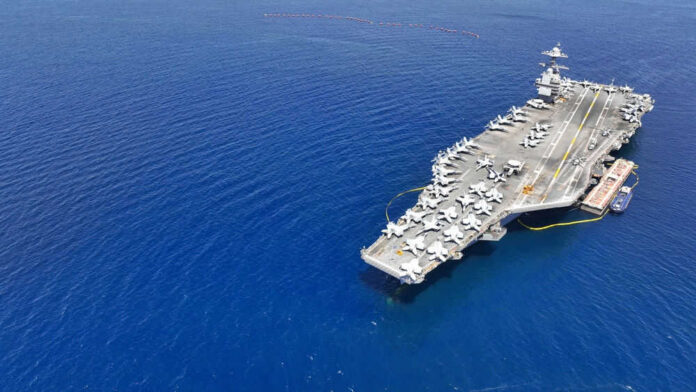
President Trump deploys the world’s largest aircraft carrier, USS Gerald R. Ford, to the Middle East in a massive show of force against Iran’s nuclear threats and brutal crackdowns, signaling zero tolerance for globalist weakness.
Story Snapshot
- USS Gerald R. Ford redirects from Caribbean operations to join USS Abraham Lincoln in the Arabian Sea, creating a rare dual-carrier power projection amid Iran tensions.
- Trump’s “maximum pressure” backs failed Oman talks, with warnings of “very traumatic” consequences if no nuclear deal emerges soon.
- Ford’s crew faces an 8+ month deployment extension, showcasing advanced EMALS tech for 160 daily sorties to deter Iranian missiles and proxies.
- Move contrasts with Biden-era hesitancy, prioritizing American strength over endless Middle East entanglements while protecting vital oil routes.
Deployment Timeline Unfolds
USS Gerald R. Ford departed Norfolk in late June 2025 for Europe, then redirected to the Caribbean in late October 2025 for Venezuela operations, capturing Nicolás Maduro. On February 12, 2026, the crew received notification of redeployment to the Middle East. Officials confirmed the move on February 13, with the carrier and destroyers en route to join USS Abraham Lincoln, deployed January 26 in the Arabian Sea. This dual presence marks a significant escalation.
Trump’s Maximum Pressure Strategy
President Trump initiated indirect talks with Iran in Oman in early February 2026, following his Axios interview, signaling a second carrier if negotiations fail. On February 12, Trump stated a deal is needed quickly or face very traumatic consequences. The deployment supports his campaign to curb Iran’s nuclear program, missile arsenal, and proxy support for Hamas and Hezbollah. This echoes his 2019 tactics, rejecting the failed 2015 JCPOA that empowered Tehran under prior administrations.
A second U.S. aircraft carrier is expected to deploy to the Middle East as the U.S. negotiates with Tehran about its nuclear program and potential strikes against Iran if those talks don't work out. NewsNation's @RobertShermanTV reports. More: https://t.co/AoCpQBuTZy pic.twitter.com/za1bAtPAJB
— NewsNation (@NewsNation) February 13, 2026
Escalating Tensions with Iran
Iran’s June 2025 clash with Israel degraded its air defenses but left missiles intact. Late December 2025 to early January 2026 saw Tehran crush nationwide protests, killing thousands. Failed Oman and Qatar talks prompted U.S. buildup. The Strait of Hormuz, carrying 20% of global oil, risks mining or blockade. Gulf states fear spillover, while Israel under Netanyahu urges action against Iran’s threats. Trump’s resolve counters Iranian resistance to nuclear curbs.
U.S. military superiority includes Ford’s F-35s and EMALS catapult system, enabling unmatched sortie rates. Iranian leadership manages domestic unrest while relying on asymmetric tactics. This power dynamic favors American deterrence, protecting allies and energy security from regime aggression.
Impacts on Sailors, Economy, and Security
Ford’s 4,500 sailors endure extended sea time, delaying homecoming to late April or early May 2026. Short-term risks include miscalculation leading to missile strikes on bases or Hormuz disruption, spiking oil prices. Long-term, it pressures a nuclear deal or risks conflict, straining Navy resources. Politically, it bolsters Trump’s strongman image, prioritizing strength over the globalist overspending and weakness of past policies. Defense sector highlights Ford’s cutting-edge capabilities.
Sources:
US orders its largest aircraft carrier to Middle East in show of force to Tehran
Second U.S. aircraft carrier is being sent to the Middle East, AP source says, as Iran tensions grow
2026 United States military buildup in the Middle East
Aircraft carrier Gerald Ford Middle East Iran Trump
USS Gerald Ford aircraft carrier headed from Caribbean to Middle East