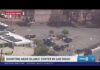
Officials insist the Longview paper mill disaster is “stable” and not a threat to the public, even as families wait for answers about a deadly rupture in an 80,000-gallon chemical tank and the workers who never came home.
Story Snapshot
- One worker is confirmed dead, at least 10 are injured, and multiple employees remain unaccounted for after a white-liquor tank catastrophically failed at a Longview, Washington paper mill.
- Fire officials say the incident scene is “stable” and in “recovery phase,” while also warning the damaged tank remains unstable and dangerous to responders.
- Authorities emphasize there is “no immediate threat” to the surrounding community, yet the cause of the rupture is unknown and the investigation has barely begun.
- The clash between reassuring public statements and the severity of the accident raises hard questions about industrial safety, transparency, and trust.
Deadly rupture at a high-hazard paper mill
Emergency crews in Longview, Washington were dispatched around 7:15 a.m. after an industrial tank containing white liquor suddenly ruptured at the Nippon Dynawave Packaging kraft pulp and paper mill.[2] White liquor is a highly corrosive chemical mixture used to break down wood chips in the papermaking process, and the ruptured vessel was an estimated 80,000-gallon tank that was about 60 percent full when it failed.[2][3] The failure unleashed a mass casualty event on the plant floor.
Several employees are still missing after a chemical tank ruptured at a facility in Washington state, leaving multiple people critically injured and at least one person dead, authorities said. pic.twitter.com/brUptNe1HN
— Breaking911 (@Breaking911) May 27, 2026
Authorities confirmed that at least ten people were injured, including a firefighter, with several suffering critical or life-threatening chemical burns and inhalation injuries.[1][2][3] One person transported to the hospital died, and officials later acknowledged that additional fatalities had occurred, though they initially withheld the total number pending family notification.[1][2][3] Nine workers remained unaccounted for in the immediate aftermath, turning the site into both a hazardous scene and an active search-and-recovery operation.[1][4]
“Stable” scene, unstable tank, and worried families
Longview Fire Department Battalion Chief Mike Gorsuch and Cowlitz 2 Fire & Rescue Chief Scott Goldstein told reporters that the incident was “stable” and in a “recovery phase,” stressing that hazardous-materials teams and fire crews were working closely with plant staff to secure the area.[2][4] At the same time, Goldstein warned that the damaged tank itself remained unstable and posed an ongoing danger to personnel trying to recover missing workers and fully secure the facility.[1][4]
Officials repeatedly emphasized there was no immediate threat to the surrounding community, a message echoed in a joint statement from the company and response agencies.[1][2][4] Residents were urged to avoid the area while operations continued, but authorities stated that current monitoring had identified no direct public hazard beyond the plant’s perimeter.[1][2][4] From a common-sense perspective, that kind of calm, limited message makes sense for avoiding panic, but it also narrows the conversation before the facts are in.
Cause unknown, responsibility unanswered
Fire officials and company representatives acknowledged that the cause of the rupture remained unknown, with structural and hazardous-materials assessments still underway.[1][2][4] Early reports confirmed what failed—a massive white-liquor process tank—and roughly how it was operating at the time, but provided no explanation for why it imploded or ruptured so violently.[2][3] Without corrosion data, inspection records, or operating logs, no one can credibly claim yet that this was “just an accident” or, conversely, a clear case of negligence.
The severity of harm—fatalities, critical injuries, and missing workers—is entirely consistent with a serious breakdown in process safety, even if investigators have not traced the chain of failure.[1][3][4]
Common sense says that when a high-hazard vessel containing tens of thousands of gallons of corrosive chemicals catastrophically fails, the public deserves more than generic assurances that “industrial sites have strong safety protocols.” That talking point may be true in the abstract, but it does not answer whether this specific tank, maintenance regime, or safety culture fell short.
Reassurance, information control, and public trust
Press briefings and joint statements framed the Longview scene as controlled and steadily progressing toward recovery, with officials highlighting coordination among agencies, focus on returning workers to their families, and absence of an off-site threat.[1][2][4] That tone mirrors a familiar pattern in industrial accidents: secure the perimeter, calm the public, and postpone talk of fault until after formal investigations. From an emergency-management standpoint, that is understandable; from a transparency standpoint, it can feel premature.
Here's what to know about the deadly tank rupture at a Longview paper mill https://t.co/c43LjVpnlJ
— KGW News (@KGWNews) May 27, 2026
Americans often balance respect for local first responders with skepticism toward large industrial operators and bureaucratic spin. In Longview, the record so far shows commendable on-the-ground response—rapid triage, hospital transports, and ongoing recovery—alongside a communications strategy that downplays unresolved questions about cause and compliance.[1][2][3][4]
Until investigators release hard findings on what went wrong with that 80,000-gallon tank, the most responsible stance is cautious: support the rescuers, pray for the families, and insist on full, unvarnished answers.
Sources:
[1] Web – Deaths reported after tank implodes at Washington pulp and paper mill
[2] YouTube – Officials give update on deadly Longview chemical explosion
[3] YouTube – Multiple people killed, 10 hurt in Longview, WA chemical explosion
[4] YouTube – Number of people missing after deadly chemical explosion at …