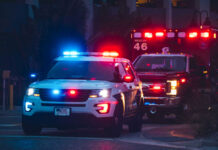


Shots, smoke, and a house in flames ended Sunday dinner with eight family members dead in Billings.
Story Snapshot
- Police said eight victims—four children and four adults—were killed at 315 White Star Circle.
- Officers heard gunfire, then saw smoke and flames as the home became fully engulfed.
- One person was taken to a hospital and later died; there was no threat to the public.
- Reports named 44-year-old Allen Smith as the alleged shooter and relative of the victims.
Police Timeline: A Family Disturbance Turns Deadly
Billings Police said the 911 call came at 6:01 p.m. for a family disturbance at 315 White Star Circle. The first officer arrived at 6:12 p.m. and heard shots from behind the house. By 6:15 p.m., smoke and flames rose from the home. Crews moved to rescue and containment.
Police later confirmed eight victims, four children and four adults, were found dead. One person was taken to a local hospital at 6:48 p.m. and later died, raising the toll to nine including the suspect.
City leaders urged calm and pledged support. The mayor called the loss horrific and said the community is heartbroken. Law enforcement secured the area and told neighbors there was no ongoing threat. The Yellowstone County Sheriff’s Office echoed that message as crews worked the scene.
Recovery and identification efforts took time due to the intense fire damage. Police described a complex scene with active recovery of remains and careful processing that would span days.
What Witnesses And Reports Say About The Suspect
News outlets reported that 44-year-old Allen Smith was related to the victims and was the alleged shooter. The attack happened as relatives gathered for Sunday dinner at the home outside Billings. The same reports said he died after being taken to a local hospital.
Those accounts align with police statements on the sequence and the single-hospitalized person who later died. Authorities had not yet released the full identities of the victims at the time of those reports.
Montana gunman who massacred 8 family members at Sunday dinner ID'd as clues about possible motive revealed https://t.co/cz6Vv9v3mB pic.twitter.com/BUgmqZhh4U
— New York Post (@nypost) August 25, 2026
Police have not publicly detailed a motive. The scene’s damage and the fast-moving fire make that work slower. Family mass killings often stem from domestic breakdown, control, or rage.
Research shows these crimes are usually carried out by a male family member and often end in the offender’s death. Firearms are common in these attacks, and stressors like family conflict or money trouble often sit in the background.
How The Fire Complicated Rescue And Recovery
Responders faced two dangers at once: an active shooter and a growing fire. Officers arriving under gunfire must first stop the threat. Firefighters cannot safely fight flames until police secure the scene. That sequence costs minutes that matter.
By the time crews advanced, the home was fully involved. Police later said that the active recovery of the remains would take days. That is standard when high heat and the risk of collapse block access to rooms and hallways.
Family dinner ended in a massacre: American man killed eight relatives
In Billings, Montana, a 44-year-old man killed eight relatives, then set the family home on fire and took his own life. Among the victims were his parents, his 92-year-old grandmother, his sister and four… pic.twitter.com/NrRsJcPt6U
— NEXTA (@nexta_tv) August 26, 2026
Reports across local outlets matched on key points. Officers arrived minutes after the 911 call. Shots rang out. Smoke followed. Flames took the structure. Eight victims were found, and a ninth person died at the hospital.
City officials spoke to calm fears and confirmed there was no wider public danger. While early numbers in fast events can shift, the final toll and the core sequence now stand on consistent, on-record reporting.
Why This Case Fits A Larger Pattern
Criminology treats family annihilation as distinct from random mass shootings. The victims tend to be relatives in the same home. The offender is often male and sometimes kills himself or dies after law enforcement arrives. Many cases erupt amid domestic conflict.
That pattern lines up with what Billings Police called a family disturbance that turned violent. The blend of a domestic setting, multiple child victims, and a fatal end for the suspect fits that profile.
What Comes Next For Billings
Police will finish scene work, confirm identities, and outline causes of death. Fire investigators will study burn patterns to learn how the blaze started.
The coroner will fix time and cause of death for each victim and for the suspect. These steps matter for truth and for any future safety policies.
Leaders will face hard questions on domestic-violence warning signs and family support. Faith groups and neighbors will carry the families now and long after the cameras leave.
Sources:
apnews.com, nbcmontana.com, montanarightnow.com, billingsgazette.com, pmc.ncbi.nlm.nih.gov