

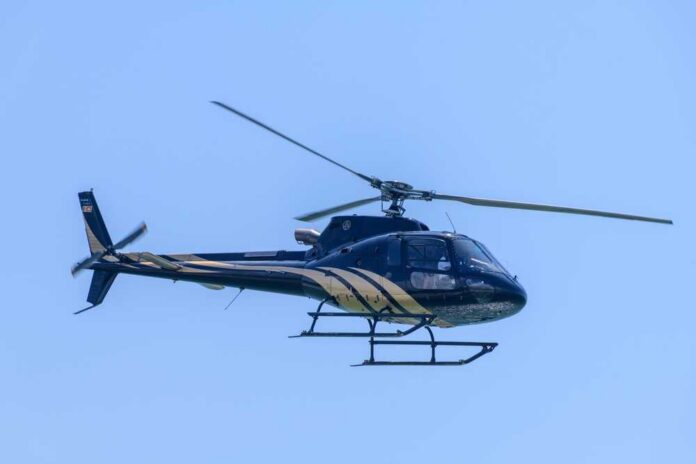
A medevac helicopter carrying five people plunged into the Pacific Ocean just minutes after leaving Catalina Island, killing two and leaving one person still missing.
Story Snapshot
- A REACH Air Medical Services helicopter crashed into the water shortly after takeoff from Catalina Island on the evening of September 30.
- Five people were aboard; two died at the scene, two were hospitalized, and one remains unaccounted for.
- Los Angeles County Fire, the Sheriff’s Department, Avalon Fire, and the U.S. Coast Guard launched a joint search-and-rescue response.
- REACH Air Medical Services confirmed one of its aircraft was involved and said patient well-being was its top concern.
What Happened Off Catalina Island
The helicopter went down in the ocean near Avalon just before 8 p.m., according to multiple local reports. Los Angeles County Supervisor Janice Hahn said she was told a medevac helicopter leaving Catalina Island had crashed “shortly after takeoff” and that crews were already racing to the scene. The timing lined up closely across outlets, with several placing the first emergency calls around 7:50 p.m..
Rescue teams pulled survivors from the water within the first hours of the response. Los Angeles County Fire officials confirmed two people died at the scene, while two others were taken to mainland hospitals.
A fifth person remained missing as search crews worked through the night, combing the waters off Avalon and Pebbly Beach for any sign of the last occupant.
Who Responded And Who Confirmed The Crash
The rescue effort pulled in agencies across land, sea, and air. Los Angeles County Fire, the Sheriff’s Department, Avalon Fire, and the Coast Guard all sent personnel to the crash site.
That kind of fast, multi-agency buildup signals how seriously officials treated the incident from the first minutes, even before a full picture of casualties had come together.
REACH Air Medical Services, the operator whose aircraft was involved, released a brief statement acknowledging the crash. A company spokesperson said, “We are aware of an incident involving a REACH Air Medical Services helicopter… Our immediate concern is for the well-being of those involved.”
The statement stopped short of detailing the flight’s mission or who exactly was on board, which is typical for an operator during the opening hours of an active emergency.
Why The Early Numbers Shifted
As with most fast-moving disasters, the public details evolved as crews worked. Some early reports described four people rescued from the water, while others said three were pulled out by boat crews and two more were spotted separately by the Coast Guard.
These differences reflect how a chaotic night-water rescue unfolds in real time, not any dispute about the core facts: a crash happened, people died, and one person is still missing.
Reports also varied slightly on the condition of the two hospitalized survivors, with some describing them as stable and others saying their status was not yet confirmed publicly.
None of the credible reporting contradicts the basic sequence of events. It simply shows how details sharpen as official agencies confirm information stage by stage.
What Air-Medical Safety Data Shows
Medical helicopter flights make up a small slice of all helicopter traffic nationwide, yet they show up disproportionately often in fatal crash statistics.
Federal Aviation Administration research has repeatedly tied these accidents to night flying, fast dispatch decisions, and tough weather calls made under pressure.
None of that explains this specific crash, but it shows why air-ambulance operators face constant scrutiny over how they balance speed with safety.
Past National Transportation Safety Board investigations into similar helicopter ambulance crashes have found causes ranging from pilot disorientation to mechanical failure to basic preflight oversight.
A full accounting of what brought this helicopter down off Catalina will depend on investigators recovering wreckage, reviewing flight data, and interviewing surviving crew once the search effort concludes.
What Comes Next For Families And Investigators
For now, the priority on the water remains finding the one person still missing. Search crews have continued operations along the island’s coastline, working against fading daylight windows and open-ocean conditions that make recovery efforts slow and difficult.
Families of those aboard are waiting on agencies to formally confirm identities before any additional details become public.
#BREAKING Medical Helicopter Crash.
Two people have died and two others were injured another is missing after a REACH Air Medical Service helicopter crashed in the waters just seconds after taking off from Pebbly Heliport on Catalina Island.
There is a search for the missing… pic.twitter.com/zeFCD3AsAe
— Tony Perez (@Tony_MNNews) October 1, 2026
Catalina Island depends heavily on helicopter transport for emergencies, since ferry travel to the mainland can take over an hour.
That reliance makes incidents like this one hit especially hard for island residents, who often view air-medical crews as a lifeline rather than just another transportation option. A full investigative report will take time, but the human toll from this night is already clear.
Sources:
latimes.com, ktla.com, spectrumlocalnews.com, usnews.com, kesq.com, kcra.com, thenationaldesk.com, cbsnews.com, aol.com