

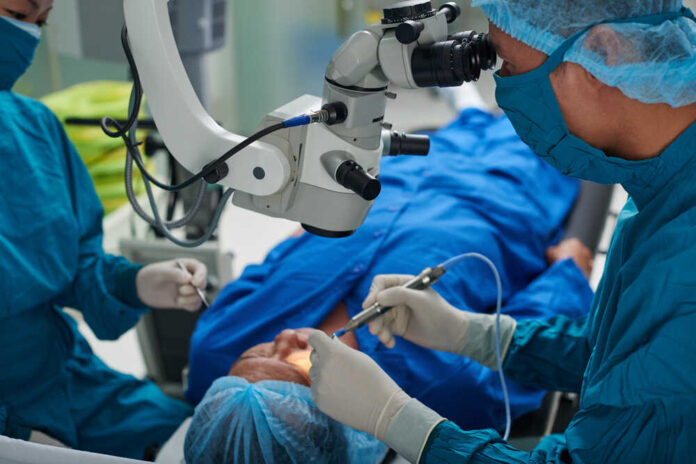
Revolutionary eye implants are restoring the gift of sight to legally blind Americans, delivering a technological triumph that embodies the innovation and hope that defines our great nation.
Story Highlights
- Tiny retinal implants paired with special glasses enable legally blind patients to read letters and words again.
- Argus II and PRIMA devices have received FDA approval and show remarkable success in clinical trials.
- American innovation leads the world in artificial vision technology, offering hope to millions.
- Patients gain independence from government assistance programs through restored reading ability.
American Innovation Leads Vision Restoration Breakthrough
American medical technology companies have achieved what many thought impossible—restoring functional vision to the legally blind. The Argus II system, developed by Second Sight, and the PRIMA device by Science Corporation represent cutting-edge achievements in biomedical engineering.
These revolutionary systems combine surgically implanted microchips with specialized camera-equipped glasses, stimulating remaining retinal cells to restore partial vision. The FDA approved the Argus II in 2014 after rigorous clinical trials demonstrated patients could read letters and words for the first time in years.
Eye implant trial that helps blind patients read again shows "astounding" results https://t.co/x6kx6GNeq3
— BBC Breaking News (@BBCBreaking) October 20, 2025
Restoring Independence Through Advanced Technology
These remarkable devices target patients suffering from retinitis pigmentosa and geographic atrophy, conditions that have historically condemned Americans to permanent blindness. The technology works by bypassing damaged photoreceptors and directly stimulating healthy retinal cells.
Clinical trials confirm that hundreds of patients worldwide now benefit from these systems, with reproducible spatial resolution and stable long-term function. Dr. Lisa Olmos de Koo from UW Medicine emphasizes that retinal prostheses offer genuine hope for patients with no other treatment options.
The impact extends far beyond medical achievement. Patients who regain reading ability reduce their dependence on costly government assistance programs and social services.
This technological breakthrough demonstrates how American ingenuity creates solutions that restore individual dignity and self-reliance. Families no longer bear the full burden of caregiving, and patients can pursue employment opportunities previously impossible due to vision loss.
Expanding Horizons for Future Treatment
Research continues to advance artificial vision capabilities, with new technologies, including optogenetics and cortical implants, entering human trials. Stanford University’s Daniel Palanker describes current times as “exciting” for visual prostheses development.
While present devices offer limited vision beyond reading capability, ongoing research aims to improve image sharpness and spatial resolution.
The PRIMA device clinical trials in Europe show significant improvements for patients with dry age-related macular degeneration, expanding treatment possibilities.
This American-led innovation represents conservative values in action—private enterprise solving real problems without government mandates or bureaucratic interference.
The collaboration between academic institutions, private companies, and regulatory agencies demonstrates how free-market capitalism drives medical breakthroughs that improve lives.
These achievements underscore America’s continued leadership in medical technology and our commitment to helping citizens achieve independence through innovation rather than dependency through government programs.
Sources:
Clinical trial results for retinal prosthesis reading capability
UW Medicine retina implant research findings
USC research on improving retinal implant image quality
Science Magazine coverage of artificial vision advances