Washington is signaling that the U.S. strike campaign against Iran won’t be a quick show of force—but a weeks-long push with escalating pressure and real risks for American troops and global energy markets.
Quick Take
- President Trump says Operation Epic Fury is expected to last roughly 4–5 weeks, with strikes set to intensify as the regional war spreads.
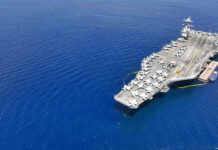
- The campaign followed failed nuclear talks and a major U.S. naval buildup in the region, with CENTCOM and Israel conducting coordinated operations.
- Iran retaliated with large missile volleys targeting Israel and Gulf locations, including a strike that hit a U.S. base in Bahrain, according to the conflict timeline.
- Reports cite at least six U.S. troop deaths early in the fighting, alongside hundreds of reported Iranian deaths amid continued strikes.
Trump’s Weeks-Long Timeline Signals a Sustained Campaign
President Donald Trump has publicly framed the U.S.-Israel strike campaign—Operation Epic Fury—as a sustained operation expected to run weeks, not days, with administration messaging pointing to an intensifying phase rather than a rapid off-ramp.
Reporting compiled in conflict timelines describes Trump citing multiple objectives, including preventing a nuclear-capable Iran, degrading missile threats, and reducing the regime’s ability to project force across the region. The stated timeline matters because it sets expectations for a prolonged military tempo and a higher risk of retaliation.
As conflict in Mideast widens, US says attacks on Iran will last weeks and intensify https://t.co/ZDSXvj1EwE
— WPMT FOX43 (@fox43) March 3, 2026
Operationally, the timeline traces a fast pivot from diplomacy to force. Indirect nuclear talks began in early February and later collapsed after additional rounds, followed by a late-February order authorizing strikes and a public announcement of air operations the next morning.
The sequence underlines a central reality: when negotiations fail, events move quickly in the Middle East, and Americans are left managing the consequences—threats to troops, shipping lanes, and regional bases that can’t be “paused” by press releases.
How the Conflict Expanded and Why It’s Hard to Contain
Accounts of the first week describe rapid escalation across multiple theaters, with Iran launching large missile attacks toward Israel and Gulf targets and the U.S. and Israel responding with additional waves aimed at air defenses, missile infrastructure, and command-and-control assets.
The timeline also describes drones and missiles being intercepted in the Gulf and attacks reaching U.S. facilities. The widening footprint is the key strategic problem: once multiple countries and proxy actors are involved, escalation control becomes harder and miscalculation becomes easier.
Some of the most consequential claims involve leadership and command disruption inside Iran. Strike reporting and timelines describe “decapitation” operations and subsequent uncertainty about succession and internal control, alongside measures such as internet disruptions and emergency economic steps like export restrictions.
Those details, if accurate, point to a pressure strategy aimed at degrading regime capability rather than conducting a limited punitive raid. At the same time, open questions remain about the durability of Iran’s command structure and the pace at which it can reconstitute missile and drone operations.
Costs, Tradeoffs, and the Constitution-Level Questions Voters Watch
Early casualty reporting includes six U.S. troop deaths by March 1, alongside claims of hundreds of Iranian deaths and ongoing strikes and counterstrikes. Those figures underscore the most sobering part of a “weeks-long” plan: time expands the exposure window for Americans in uniform at bases, embassies, and on ships.
For voters who remember years of unclear objectives overseas, the administration’s stated goals and defined timeline will be scrutinized for realism—especially if the operation drifts beyond its original scope.
Oil, Shipping, and the Domestic Ripple Effects of a Long Campaign
Regional escalation places immediate focus on energy and shipping chokepoints, including threats tied to the Strait of Hormuz, while the U.S. posture reportedly includes preparations connected to protecting oil transit.
Even without a full closure, heightened risk can disrupt routes, raise insurance costs, and tighten supply expectations—dynamics that can feed higher prices at home. For Americans still frustrated by the inflationary fallout of past fiscal and energy policies, any overseas shock that squeezes fuel and shipping costs is more than foreign news—it hits the family budget.
As Mideast conflict widens, US says attacks on Iran will last weeks and intensify https://t.co/brBRbFW6tQ
— Yuri Kageyama (@yurikageyama) March 3, 2026
The available reporting also shows unresolved tension between two tracks: coercive military pressure and the idea of returning to negotiations. Timelines describe mixed signals—U.S. openness to a proposal alongside reported Iranian rejection by senior figures.
With the fighting expanding and the operation projected to intensify, the practical question becomes whether diplomacy can re-enter on terms that actually reduce the threat—particularly nuclear and missile capacity—rather than repeat the cycle of temporary deals and future escalation. For now, the public posture is clear: the campaign is designed to last.
Sources:
https://en.wikipedia.org/wiki/Prelude_to_the_2026_Iran_conflict
https://en.wikipedia.org/wiki/Timeline_of_the_2026_Iran_conflict
https://globalnews.ca/news/11713036/iran-war-timeline-what-you-need-to-know/