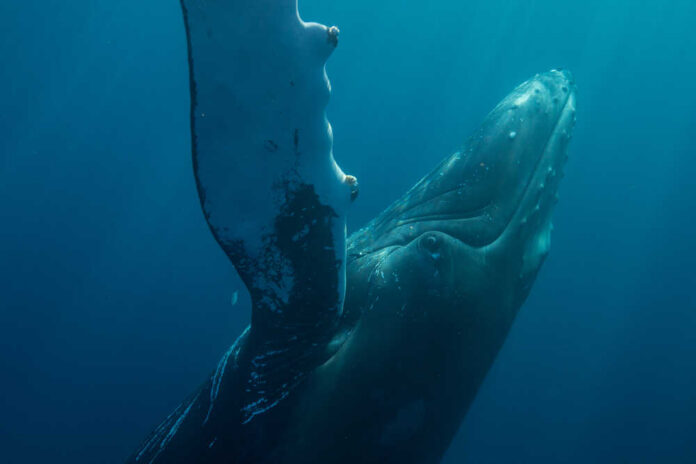
After days of high-tech, high-effort rescue attempts, German authorities have concluded that a humpback whale stranded in the Baltic Sea is unlikely to survive—an outcome that underscores the hard limits of human intervention against nature.
Story Snapshot
- Rescuers halted active efforts on April 1, 2026, saying the humpback whale stranded near Poel island by Wismar is expected to die.
- Teams previously freed the whale at least once using an excavator-dug channel after it stranded near Timmendorfer Strand.
- Drones and close checks showed irregular breathing, minimal movement, and weakening as water levels dropped in a shallow inlet.
- Experts say humpbacks rarely enter the brackish Baltic, where low salinity and limited prey make survival difficult.
Rescuers End Intervention as the Whale Weakens Near Poel Island
Rescue teams along Germany’s Baltic coast ended active intervention on Wednesday, April 1, after concluding a stranded humpback whale near Poel island outside Wismar was too weak to save.
Scientific coordinator Burkard Baschek of Ocean Museum Germany said the animal’s prospects were “very small,” with observers reporting irregular breathing and little response to boats. Falling water levels in the shallow inlet limited options and increased stress on the animal.
Authorities shifted their approach to what they described as “maximum rest and respect for nature,” meaning fewer close approaches and no further aggressive attempts to force the whale back to deeper water.
Drone imagery reportedly showed the whale largely inactive in sediment, reinforcing the view that it was exhausted after repeated strandings and repeated efforts to help it. Officials also emphasized that any intervention had to weigh feasibility and the risk of further harming the animal.
A Multi-Day Rescue Effort Included Excavators, Boats, and Drones
The current crisis followed a dramatic sequence that began days earlier near the resort town of Timmendorfer Strand in Schleswig-Holstein, where the whale became stuck in very shallow water. Initial efforts included attempts to generate waves with boats, but the most decisive step was digging an escape channel with an excavator.
That operation helped free the whale early on Friday, March 27, and for a brief moment it appeared the rescue had worked as intended.
A young humpback whale, named Timmy by rescuers, was struggling to find its way out of shallow bays off the Baltic coast of Germany after a week-long ordeal that has put its survival in doubt pic.twitter.com/rmrkcAPLwY
— Reuters (@Reuters) March 29, 2026
The whale’s freedom did not last. By Saturday, March 28, the humpback was spotted stranded again near Wismar Bay in Mecklenburg-Vorpommern, a development confirmed by Greenpeace as monitoring continued.
By Tuesday, March 31, the whale entered a shallow inlet near Poel island and stranded once more, leaving responders facing a familiar problem in a location where tides, sandbanks, and narrow channels can quickly turn a rescue into a prolonged ordeal.
Why the Baltic Sea Is a Trap for Humpbacks
Marine experts say humpback whales do not typically venture into the brackish Baltic Sea, where low salinity and limited prey can create conditions unsuitable for prolonged survival. Reports cited concerns including skin disease and nutritional issues, which can worsen when an animal is stressed and repeatedly stranded.
Returning to the Atlantic would require navigating hundreds of kilometers through German and Danish waters, a difficult route for an already weakened whale.
Available reporting offers theories for why a humpback might enter the Baltic, including chasing herring shoals or simple navigational error, but the underlying point remains clear: the Baltic is not normal habitat for these animals.
When a large whale ends up in shallow coastal inlets, rescue becomes a race against time and physics. Heavy equipment and boats can sometimes help, but they cannot change tides, salinity, or geography.
A Lesson in Limits, Costs, and the Role of Government Response
German officials described strong public interest and extensive on-scene attention, including live updates and televised briefings, as the whale’s condition declined. The emotional pull is understandable, but the case also illustrates a broader reality: government-led response efforts—even when well-intentioned—hit hard limits when conditions are wrong.
Once repeated interventions fail, responsible authorities must decide whether continued action helps the animal or merely prolongs suffering.
In this case, the decision-makers emphasized an ethical shift away from constant interference toward minimizing stress on the whale as it weakened. The reporting available does not provide a detailed accounting of costs or manpower, and there is no indication of political fallout.
What is documented is a coordinated effort involving scientific leadership, local agencies, and outside observers—followed by a final assessment that technology and determination were no match for the animal’s declining state and the unforgiving terrain.
Sources:
Rescuers lose hope for the humpback whale stranded in the Baltic Sea
Rescuers give up hope for humpback stranded in Baltic Sea
Rescuers lose hope for the humpback whale stranded in the Baltic Sea
Humpback whale freed by rescuers in Baltic Sea has become stranded again