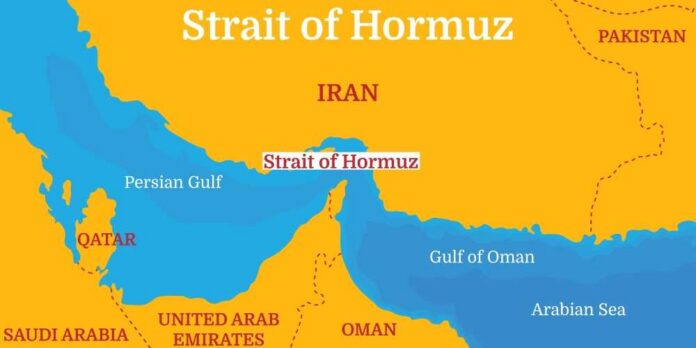
Iran’s latest strikes didn’t just hit oil assets—they hit the chokepoint that keeps everyday American prices from exploding.
Quick Take
- Iran declared the Strait of Hormuz a “war zone,” pushing shippers to reroute and tightening global supply lines.
- Coordinated missile and drone attacks hit Gulf infrastructure, including refineries, storage hubs, and a major desalination-linked power site.
- Force majeure declarations and missing shipping insurance are disrupting deliveries under oil and LNG contracts.
- Oil prices spiked amid fears of a near-blockage scenario, raising the risk of another inflation shock.
Infrastructure Warfare Rewrites the Risk for Global Energy
Iranian strikes across the Gulf have shifted the conflict from conventional military targets to infrastructure that underpins modern life—energy, water, and logistics.
Reporting ties the escalation back to a February 28 U.S.-Israeli operation against Iranian military and nuclear-linked facilities, followed by Iran’s March 5 declaration that the Strait of Hormuz is a “war zone.” That sequence matters because markets price oil on expected disruption, not just confirmed damage.
The March 9 wave of attacks reportedly struck multiple sites across Bahrain, the UAE, and Oman, including the Hidd Independent Water and Power Project in Bahrain and the Vopak Horizon Fujairah Terminal in the UAE.
Analysts have highlighted the significance of hitting desalination-adjacent infrastructure because Gulf states rely on desalination for potable water and maintain limited reserves. That reality turns civilian utilities into strategic leverage points, raising the stakes beyond barrel counts.
Oil prices are nearing $100 as WTI sits at $99.30 and Brent at $99.29, with the Middle East conflict driving the surge. This could be a dangerous level for the global economy. pic.twitter.com/Tw0LGqoHnT
— Alessandro Bazzoni (@Alessandro7596) March 14, 2026
The Strait of Hormuz Squeeze Is the Real Economic Trigger
The Strait of Hormuz is not a talking point—it is a physical bottleneck for a large share of global oil and LNG flows. When Iran warned ships away and risk pricing jumped, shipping behavior followed: major lines reportedly rerouted around the Cape of Good Hope, adding time and cost.
Separate reporting described about 150 ships sitting at anchor in the strait, effectively waiting out the insurance and security uncertainty that can freeze commerce without a formal blockade.
Port disruption compounded the squeeze. Jebel Ali in Dubai, one of the world’s busiest container ports, reportedly suspended operations after a fire linked to aerial interception activity.
When container throughput and energy exports get hit in the same window, global trade absorbs the shock through higher freight rates and slower deliveries. For Americans, that translates into the same kitchen-table reality voters remember from the last inflation cycle: higher transport costs that bleed into groceries, utilities, and consumer goods.
Force Majeure and Insurance Gaps Turn a Crisis Into a Supply Cut
Multiple producers reportedly declared force majeure, including Bahrain’s Bapco Energies, QatarEnergy, and Kuwait Petroleum Corporation. In practice, that is more than legal language. When insurers won’t cover voyages through a perceived war zone, companies can’t move cargoes even if some production continues.
That is why this episode is rattling markets: it interrupts the physical flow of energy and the contractual machinery that keeps long-term deliveries predictable.
Oil Price Volatility Revives Inflation Fears—and Tests U.S. Policy
Price action has swung hard as traders weigh worst-case scenarios. Reporting described crude breaching $130 per barrel as markets priced the prospect of a near-total blockage, while other coverage noted earlier moves such as Brent jumping roughly 10% to above $82 per barrel before the more severe disruption narrative took hold.
The exact path depends on damage assessments and shipping normalization, but the direction of risk has been clear: scarcity pricing returns fast when chokepoints wobble.
Oil poised for further gains as Middle East conflict threatens export facilitieshttps://t.co/dYVAyWzsNk
— MikeCaymanTrades (@MikeJTrades) March 15, 2026
The longer-term question is whether governments treat this as a one-off spike or as proof that globalism’s “just-in-time” energy routing is fragile. The International Energy Agency outlook cited in the research points to a smaller 2026 surplus than previously expected, which reduces the cushion if Middle East flows stay impaired.
The political pressure will be to keep U.S. energy policy focused on reliability and affordability—because families feel oil shocks immediately.
Sources:
https://moderndiplomacy.eu/2026/03/02/middle-east-strikes-trigger-widespread-oil-and-gas-shutdowns/
https://www.weforum.org/stories/2026/03/us-trade-deficit-international-trade-stories-march-2026/
https://www.ajot.com/news/world-faces-largest-ever-oil-supply-disruption-on-middle-east-wariea-says
https://discoveryalert.com.au/oil-supply-disruption-middle-east-2026-geopolitical-tensions/