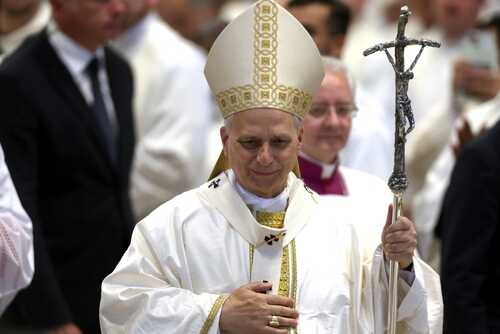
Pope Leo XIV has declared war on the machines we’re building to wage war, framing artificial intelligence in military systems as humanity’s most urgent moral reckoning since the industrial age.
Story Snapshot
- Pope Leo XIV warns that artificial intelligence in weaponry removes human accountability and triggers a destabilizing arms race with catastrophic human rights consequences
- The pontiff condemns billions spent on military technology and high-tech weapons at the expense of education and healthcare, enriching defense elites while ordinary people suffer
- He frames the challenge as fundamentally anthropological, not technical—calling for guided innovation that defends human dignity against algorithmic control and autonomous systems
- Vatican positions lethal autonomous weapons systems as incompatible with moral judgment, while Pope Leo explicitly opposes military AI development regardless of geopolitical justifications
The Spiral of Annihilation Begins with a Choice
Pope Leo XIV stood before Europe’s largest university and made a claim that cuts against the security establishment’s entire playbook: artificial intelligence in warfare does not make us safer. It makes us less human.
During his address in Rome, he drew a direct line between the billions poured into military technology and the erosion of human oversight in combat decisions. The result, he argued, is not deterrence. It is a spiral of annihilation [1].
This is not the language of diplomatic hedging. This is a pope calling the arms race what it is: a betrayal of the common good. Military spending has surged dramatically across Europe and beyond, he noted, while education and healthcare budgets shrink.
The pattern rewards defense contractors and government insiders while ordinary citizens lose access to schools and hospitals. The math is brutal: it takes only a moment to destroy, but often a lifetime is not enough to rebuild [5].
When Algorithms Replace Moral Judgment
Pope Leo XIV’s deeper concern transcends budget allocations. He has identified what he calls the anthropological crisis at the heart of artificial intelligence: the substitution of algorithmic decisions for human moral reasoning.
In his World Communications Day message, he warned that artificial intelligence systems simulate human wisdom, empathy, and responsibility without possessing any of them [1].
They invade the deepest level of human communication—the relationship between persons. When these systems are weaponized, the stakes become existential.
The Vatican’s position is unambiguous. Lethal autonomous weapon systems—machines that select and fire on targets without human intervention—violate the fundamental principle that moral judgment cannot be delegated to code [8].
Yet the world’s defense establishments continue developing exactly these systems, justified by claims of precision and speed. The pope sees this as a category error dressed in technological language: we cannot automate accountability.
The Resource Reallocation Argument
Pope Leo XIV has invoked a moral principle that challenges both Left and Right: the preferential option for the poor. Billions invested in artificial intelligence weapons systems represent a choice.
That money could fund schools, hospitals, clean water, and food security. Instead, it flows to defense contractors and military research facilities, enriching the elites the pope calls “who care nothing for the common good” [1]. This is not abstract ethics. It is a direct indictment of priorities.
The pontiff’s critique gains force from historical precedent. Pope Leo XIII faced a similar inflection point during the Industrial Revolution, when new technologies disrupted society and concentrated wealth.
The encyclical Rerum Novarum emerged as a moral response to that moment [1]. Pope Leo XIV is signaling that artificial intelligence in warfare represents an equally defining social question for his papacy. The Church’s role is to name what others will not: that this path leads away from peace and toward control.
Human Faces and Human Voices Still Matter
The pope has challenged technologists and policymakers with a deceptively simple assertion: artificial intelligence cannot replace human encounter. Machines can simulate wisdom, friendship, and empathy. But they cannot generate them.
This matters profoundly in military contexts, where machines that make targeting decisions without human faces attached to those decisions create a moral vacuum [1]. Responsibility becomes distributed across code, contractors, and commanders until no one owns the outcome.
Pope Leo XIV’s solution is not to halt innovation but to guide it. He calls for three pillars: responsibility, cooperation, and education [1]. Responsibility means maintaining human judgment in lethal decisions.
Cooperation means nations acting together to constrain the arms race rather than accelerating it. Education means teaching digital literacy so citizens understand how algorithms shape perception and behavior. These are not radical demands. They are basic safeguards against technological totalitarianism.
During a visit to Rome’s La Sapienza University, Pope Leo XIV denounced AI-directed warfare, saying it leads to a spiral of annilation, criticized increased military spending, calls for peace in Ukraine and the Middle East, and meets students from Gaza.https://t.co/2ioMgUV2e3
— Marie Coronel (@MarieCoronelSD) May 14, 2026
The Oligarchy Behind the Curtain
Pope Leo XIV has pointed to a structural reality that most security analysts avoid: a handful of companies control the artificial intelligence systems that will define warfare.
The founders of these firms have been celebrated as persons of the year, yet they exercise oligopolistic control over algorithmic systems capable of shaping behavior and rewriting history without public awareness [1]. This concentration of power is not incidental to the AI warfare problem. It is central to it.
When defense budgets flow to private contractors who also dominate consumer artificial intelligence markets, incentives align dangerously. The same algorithms that maximize engagement on social media can be repurposed for targeting. The same data streams that predict consumer behavior can predict military movements.
The pope’s concern is that this architecture of control, once normalized in warfare, will metastasize into civilian life. The spiral of annihilation begins with a choice to delegate judgment to machines. It ends with a world where humans no longer make meaningful decisions at all.
Sources:
[1] Web – Pope Leo gives stark warning on AI: We must ‘safeguard ourselves.’
[5] Web – Pope Leo’s Crusade Against AI – The European Conservative
[8] Web – Pope Leo XIV’s message on Military AI – Catholic365.com