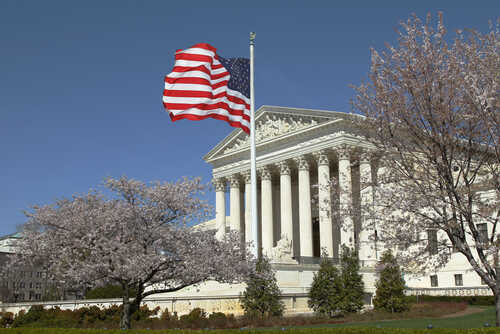
The Supreme Court’s failure to block California’s brazenly partisan congressional map has handed Democrats a manufactured advantage in the fight for House control, undercutting principles of fair representation and rewarding political gamesmanship at the ballot box.
Story Snapshot
- The Supreme Court declined to intervene in California’s Proposition 50 redistricting map despite the Trump administration backing the Republican challenge
- California voters approved the Democratic-favoring map in November 2025 as explicit retaliation against Texas Republican redistricting gains
- District Court upheld the map despite racial gerrymandering allegations, finding that partisan motives trumped racial considerations
- The decision allows California to proceed with 16 redrawn districts for the 2026 midterm elections, potentially tipping the House balance by five seats
California’s Partisan Power Grab Survives Legal Challenge
The Supreme Court’s refusal to block California’s Proposition 50 congressional map represents a significant victory for Democrats seeking to counter Republican redistricting gains nationwide. California voters approved the measure with 64 percent support on November 4, 2025, explicitly designing it to offset Texas’s Republican-favoring redistricting.
The Trump administration urged the Court to find the map unconstitutional, arguing that racial gerrymandering tainted the redistricting process despite its admitted political purpose. California Republicans filed suit within days of the ballot measure’s passage, but a three-judge federal district court panel rejected their claims in late November 2025.
Supreme Court allows new California congressional districts that favor Democrats https://t.co/LCji6EbGGk
— New York Daily News (@NYDailyNews) February 4, 2026
Tit-for-Tat Redistricting Battle Escalates Partisan Tensions
Proposition 50 emerged directly from partisan warfare over congressional maps following the 2020 census. Texas’s legislature had enacted a map adding five Republican-leaning seats, which a federal court blocked in November 2025 for alleged racial gerrymandering. The Supreme Court stayed that lower court ruling on December 4, 2025, allowing Texas to proceed with its Republican-favoring districts.
California Democrats responded by bypassing the state’s independent redistricting commission through a special election ballot measure, creating their own advantageous map as explicit retaliation. This escalating cycle of partisan redistricting threatens to undermine neutral redistricting principles established through reforms like California’s Propositions 11 and 20.
Racial Gerrymandering Claims Meet Partisan Reality
Republican challengers and the Trump administration’s Solicitor General D. John Sauer argued that Proposition 50 constituted unconstitutional racial gerrymandering, pointing to the mapmaker’s social media posts boasting about maintaining Latino voting power.
However, the three-judge district court panel, led by Judge Josephine Staton, found the evidence of racial motivation “exceptionally weak” compared to overwhelming partisan intent. California officials demonstrated that Latino populations actually decreased in a key redrawn district, contradicting claims of race-based packing.
The court’s deference to voter approval through the ballot measure process reflects troubling prioritization of political outcomes over constitutional standards, even when 11 million voters participate in what amounts to partisan gerrymandering by popular vote.
Election Timing and House Balance Implications
California invoked the Purcell principle, which cautions against late changes to election procedures that risk voter confusion, noting that candidate signature collection began December 19, 2025. The Supreme Court’s inaction effectively endorses this argument, allowing the redrawn districts to govern the 2026 midterm elections despite ongoing constitutional questions.
With five House seats potentially shifting based on the new map, the decision carries national implications for congressional control during President Trump’s administration.
The asymmetry between the Court’s treatment of California’s Democratic-favoring map and its earlier intervention to allow Texas’s Republican-favoring districts raises concerns about the consistent application of redistricting principles. This double standard undermines confidence in neutral judicial oversight of the electoral process at a critical moment for representative government.
Sources:
California Asks Supreme Court to Reject GOP Map Challenge – Democracy Docket
California GOP Urges Supreme Court to Freeze New Congressional Map Before Midterms – Courthouse News