

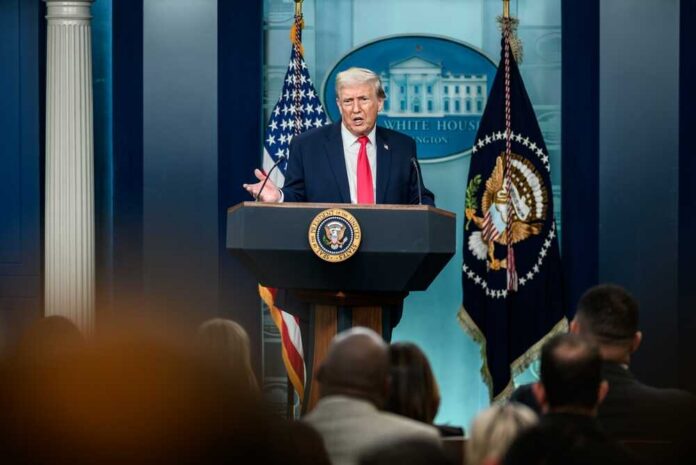
President Trump has discussed moving the White House press corps out of the West Wing, a shift that would rewrite modern press access at 1600 Pennsylvania Avenue.
Story Snapshot
- Trump has weighed relocating the press corps to another building; no final decision yet.
- Allies, including Steve Bannon per reports, have pushed the idea amid rising tensions.
- The Brady Room has housed the press since 1970, placed over a former indoor pool.
- Past presidents have moved press events off-site during renovations and for space needs.
What Trump Is Weighing And Why It Matters
CBS News reported that Trump spoke with confidants about moving the press corps out of the West Wing to another building. Two people close to the president said the idea is under discussion, with no final decision made. The White House did not shut the door. A spokesman said all options remain on the table and that any announcement would come when appropriate. That signals an active review, not a trial balloon that already popped.
The James S. Brady Press Briefing Room sits above the old indoor pool. It has served as the home base for reporters since the television era took hold and the press corps outgrew scattered spaces. Richard Nixon approved the conversion in 1969 to give television crews and print reporters a fixed, wired location near senior staff. That design embeds the press in the daily bloodstream of the West Wing, which is why any move would change more than a street address.
The Historical Playbook Presidents Have Used
White House press access has never been frozen in amber. Harry Truman shifted press conferences from the Oval Office to the Indian Treaty Room in the adjacent Eisenhower Executive Office Building in 1945, trading intimacy for order and security. During a major overhaul from 2006 to 2007, the George W. Bush team moved reporters to temporary space across Jackson Place while the Brady facilities were rebuilt and modernized. Proximity has flexed with technology, security, and staff growth.
Trump has long cast the West Wing space as scarce and the press as too cozy. He has rejected calls to enlarge the briefing room and once told reporters he did not want them comfortable, arguing cramped seats cut grandstanding and force focus. Supporters say physical distance can curb chaos and improve security, while formal briefings, pool coverage, and rapid digital distribution preserve transparency. That sounds sensible if the new setup keeps live access and fast questions intact.
What A Relocation Would Change, Practically And Politically
Moving the press corps would alter the rhythm of coverage. Reporters rely on quick hallway scrums, unscripted moments by the colonnade, and brief drive-bys with staff. A building move adds minutes and barriers that can kill spontaneous exchanges. Broadcast networks would need new fiber lines, camera platforms, and secure gear storage. That costs time and money. It also gives the White House tighter control over who gets inside and when, which is the real prize in modern media management.
Trump weighs moving White House press corps out of building https://t.co/gpc2KQuY0y via @@YahooNews
— Leslie G. 🧐📣📚😸🍷🌷 (@kckitty) October 21, 2026
Conservatives often ask a simple question: Does the public gain clarity or lose it? A clean relocation plan could work if it preserves frequent briefings, robust pool access, and the ability to press officials in real time. The press has worked off-site before, and the republic survived. But shrink the chance to ask hard questions in the moment, and accountability suffers. Common sense says measure the plan by how fast tough questions still reach the people, not by how plush the seats are.
How We Got Here And What Comes Next
Recent weeks brought mounting friction around message control, staffing churn, and logistics. Reporting says outside allies like Steve Bannon encouraged a move as part of a broader reset. The White House’s own posture has framed access as a privilege to be structured, not an open-ended right. That framing previews the debate: institutional press access as a guardrail versus a tighter, security-first, staff-centered West Wing. The decision window appears open now, with options under review.
Sources:
cbsnews.com, nytimes.com, ca.news.yahoo.com, yahoo.com, aljazeera.com, georgewbush-whitehouse.archives.gov, whitehousehistory.org