President Trump’s second-term promise to avoid new wars is colliding with a fast-growing Middle East deployment that could pull America deeper into a high-cost conflict with Iran.
Quick Take
- More than 3,500 sailors and Marines with the 31st Marine Expeditionary Unit arrived aboard the USS Tripoli in the U.S. Central Command region on March 27, 2026.
- The war with Iran is entering its second full month, with the Pentagon expanding options while saying no decision has been made on a ground entry into Iran.
- Iran has continued strikes on U.S. and allied positions, including an attack on a U.S. base in Saudi Arabia that injured about two dozen American troops.
- Iran’s pressure on the Strait of Hormuz is amplifying energy fears, as the chokepoint carries roughly one-fifth of global oil flows.
- Trump is publicly emphasizing negotiations and delayed strikes, but Iran has denied direct talks—fueling skepticism among war-weary MAGA voters.
USS Tripoli Arrival Signals a Bigger, More Flexible War Footprint
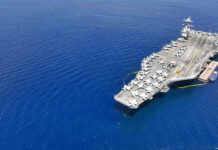
U.S. Central Command confirmed that the USS Tripoli (LHA-7) and the 31st Marine Expeditionary Unit moved into the Middle East area of operations on March 27, bringing more than 3,500 sailors and Marines into an already crowded theater.
The platform matters as much as the headcount: an amphibious assault ship can project force, evacuate civilians, support raids, and surge aircraft quickly. That flexibility also makes the deployment feel less like “deterrence” and more like preparation.
Reports indicate the Tripoli deployment adds transport and strike-capable aviation to a naval-heavy buildup that has been underway for months. The war with Iran began after U.S.-Israel strikes on Feb. 28, 2026, and U.S. operations have expanded rapidly since.
For voters who backed Trump expecting an “America First” foreign policy, the central question is whether this deployment is a limited shield for U.S. forces and shipping—or the kind of open-ended mission that history shows is hard to unwind.
U.S. Sailors and Marines aboard USS Tripoli (LHA 7) arrived in the U.S. Central Command area of responsibility, March 27. The America-class amphibious assault ship serves as the flagship for the Tripoli Amphibious Ready Group / 31st Marine Expeditionary Unit composed of about… pic.twitter.com/JFWiPBbkd2
— U.S. Central Command (@CENTCOM) March 28, 2026
Two Carriers, Thousands More Troops, and No Clear Endpoint Yet
U.S. posture in the region has included major naval power, including a two-carrier presence described as the largest since the 2003 Iraq invasion.
The buildup also includes discussions of sending additional Army forces, with plans reportedly involving 3,000 to 4,000 troops from the 82nd Airborne Division—while officials stress there is no decision to send them into Iran. That caveat is significant, but it does not erase the reality of expanding capability.
Recent reporting also places the Tripoli deployment after other Marine movements earlier in March, showing a layered reinforcement pattern rather than a one-off response.
Military analysts cited in coverage have pointed to amphibious assets and airborne forces as tools for limited missions, including seizing key terrain or reinforcing partners. In practice, “limited” missions can become broader commitments if the enemy adapts, allied objectives shift, or American leaders feel compelled to respond to new attacks.
Strikes, Retaliation, and the Risk of Escalation by Momentum
The pace of operations has been intense. Politico reported that the U.S. has struck thousands of Iranian military targets, including missile launchers, naval assets, and parts of Iran’s defense industry, and that the campaign has killed multiple Iranian leaders.
Iran, for its part, has continued to fire drones and ballistic missiles toward Israel and to hit or threaten U.S. positions and partners, including an Iranian strike on a U.S. base in Saudi Arabia that injured about two dozen American troops.
President Trump has publicly emphasized negotiations and described talks as productive, while also delaying certain strikes, including reported postponements involving Iranian power plants. Iran has denied direct talks, which creates an information gap Americans can’t easily evaluate from afar.
When leaders speak in different directions, the public tends to assume the war is being run on autopilot—an assumption that hits harder for constitutional conservatives who want clearly defined objectives, congressional accountability, and a credible plan to stop mission creep.
Hormuz, Gas Prices, and the Home-Front Squeeze MAGA Voters Feel
Iran’s pressure on the Strait of Hormuz—through disruption or blockage threats—has global consequences because the chokepoint handles about 20% of the world’s oil. That matters to American households already exhausted by years of high prices and fiscal turbulence.
Even for voters who support strong retaliation against attacks on U.S. troops, the economic downside is immediate: energy spikes ripple into groceries, shipping, and small-business costs, feeding the same inflation fears many conservatives blame on Washington’s spending and mismanagement.
The political reality is messy. MAGA voters are divided: some argue America must stand firm with allies and protect shipping lanes; others see a familiar pattern of escalation that contradicts Trump’s past vow to keep the U.S. out of new wars.
The debate is also sharpening around Israel policy, with some conservatives asking whether U.S. strategy is being driven by American interests and constitutional limits—or by outside pressures and an undefined end state.
What to Watch Next: Ground-Force Signals and War Powers Questions
The next indicators are practical, not rhetorical: whether the 82nd Airborne deployment plans become orders; whether amphibious forces shift from presence to operations; and whether the administration asks Congress for explicit authorization tied to clear aims and a measurable off-ramp.
Americans can support the troops, demand clarity from leaders, and still reject another open-ended intervention. With more forces arriving and strikes intensifying, the window for transparent, constitutional decision-making is closing.
USS Tripoli, which serves as the flagship for the Tripoli Amphibious Ready Group / 31st Marine Expeditionary Unit, arrived in its area of responsibility.
More than 3,500 U.S. Troops arrive in Middle East as Iran war strikes intensify – CBS News https://t.co/klyinWip9L
— Heather in KY (@heatherinky) March 29, 2026
For voters focused on limited government and accountable leadership, the biggest takeaway is that the Tripoli deployment expands the menu of U.S. military options at the exact moment public support is described as soft.
That combination—bigger capabilities paired with unclear political consensus—has historically produced longer wars, higher costs, and more executive-branch latitude than many conservatives are willing to tolerate, especially when the home-front pain shows up at the pump.
Sources:
Fox News Video: Report on troop arrival and Iran war escalation
2026 United States military buildup in the Middle East (Wikipedia)
Pentagon weighs deploying more troops to Middle East amid Iran war (Politico)
U.S. expected to send thousands of soldiers to Middle East, sources say (Military Times)