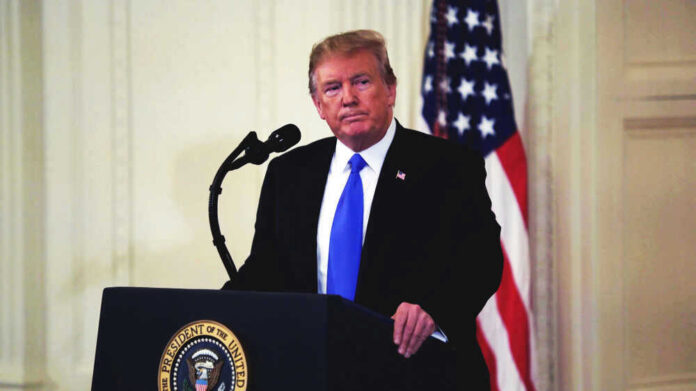
President Trump’s blunt warning that Europe faces “civilizational erasure” exposes just how far he is willing to break with the old globalist order to put America First.
Story Snapshot
- Trump blasts European leaders as “weak” and presiding over a “decaying” continent, pressing them on migration and Ukraine.
- Washington sidelines Brussels in Ukraine peace talks, signaling a major reset of U.S.–Europe power dynamics.
- Trump’s new national security strategy questions whether Europe can remain a reliable ally and urges strategic stability with Russia.
- Analysts say this marks a seismic shift away from post–World War II assumptions about NATO and the EU.
Trump Calls Out Europe’s Weakness on Immigration and Ukraine
During a December 9, 2025 interview, President Trump blasted European leaders as “weak” and overseeing a “decaying” region, zeroing in on their handling of mass migration and the war in Ukraine.
European governments have poured military, diplomatic, and financial support into Kyiv for years, yet Trump dismissed their efforts, arguing that they “don’t know what to do” and “talk but they don’t produce.”
For American conservatives, his criticism echoes long-standing concerns about elite paralysis and failed globalist management.
While European leaders staged high-profile meetings with Ukraine’s President Volodymyr Zelenskyy in London to discuss security guarantees and reject any territorial concessions to Russia, the real negotiations moved elsewhere. U.S. officials met directly with Russian and Ukrainian counterparts on a draft peace plan without Europe at the table.
That sidelining underscored Trump’s view that Brussels has become more spectator than shaper in its own neighborhood, despite years of speeches about “European strategic autonomy” and shared values.
Trump slams European leaders as 'weak' — just as they're trying to impress him https://t.co/xXDGA6VkWs
— CNBC (@CNBC) December 10, 2025
Peace Talks Without Europe and the End of Automatic Alliances
For nearly four years, the war in Ukraine has defined European security debates, but Trump’s team now appears far more focused on outcomes than on maintaining old diplomatic rituals.
European leaders view the conflict’s resolution as existential for their future security architecture, yet Washington’s willingness to pursue a plan without them signals a sobering message: influence must be earned, not assumed.
That shift aligns with Trump’s America First instinct to measure partnerships by results, not by inherited alliance habits from the Cold War era.
European funding for Ukraine remains another friction point. Leaders have floated using frozen Russian assets to finance Ukraine’s post-war reconstruction, claiming “positive progress” on a plan that still faces serious legal and political obstacles inside the EU.
For Trump, who has long bristled at endless foreign commitments and European underperformance, the idea underscores a familiar pattern: European elites searching for creative financial engineering while depending on American hard power.
Many U.S. conservatives see this as the latest example of Brussels avoiding tough trade-offs while asking Washington to underwrite European security.
Trump’s Uneasy Personal Ties With Key European Leaders
Trump’s latest remarks also sit atop years of uneasy relationships with the European political class.
He has reportedly maintained relatively smoother ties with Britain’s Prime Minister Keir Starmer, Italy’s Giorgia Meloni, and NATO Secretary General Mark Rutte, while relations with France’s Emmanuel Macron and Germany’s Friedrich Merz remain awkward.
European Commission President Ursula von der Leyen is another figure with whom rapport appears strained. That pattern reinforces how much Trump clashes with federalist, progressive Brussels insiders who champion deeper European integration and liberal social agendas.
Critics in Europe frame Trump’s style as belittling allies, but many American conservatives view it as overdue accountability for leaders who presided over uncontrolled migration, energy dependence on Russia, and bureaucratic overreach.
The suggestion that Trump is “willing to relinquish longstanding friends and tested alliances” alarms the European establishment, yet it also reflects a hard question now being asked in Washington: if allies will not meet basic security and defense expectations, how “tested” are those alliances in practice?
For voters tired of open-ended foreign entanglements, that question resonates deeply.
National Security Strategy Warns of ‘Civilizational Erasure’ in Europe
Europe’s alarm grew after the release of Trump’s new national security strategy, which warned that the continent risks “civilizational erasure” within twenty years. The document openly questions whether European countries can remain reliable allies and calls for reestablishing strategic stability with Russia.
The Kremlin praised the strategy as aligning with its own vision, prompting unease in NATO capitals that built decades of policy on viewing Moscow as the primary threat while assuming Washington’s automatic backing.
Analysts like Ian Bremmer argue the strategy makes Trump’s worldview unmistakable: a strong, united Europe is seen more as a geopolitical competitor than an automatic asset, especially when the EU acts as a regulatory superstate challenging U.S. interests.
He notes that the once “strongest” transatlantic relationship has fundamentally changed, because Trump believes a tightly coordinated EU can collectively push back against Washington in ways individual states cannot.
For conservative readers, that assessment underscores why Trump resists supranational blocs that dilute sovereignty and promote progressive social policies.