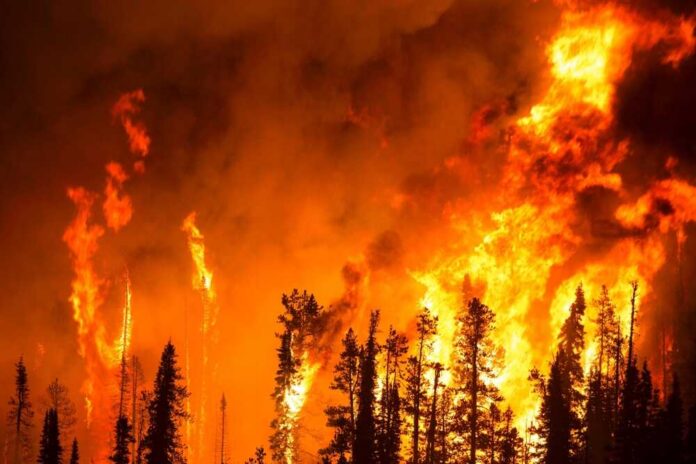
One man now stands at the center of Spokane’s wildfire nightmare, accused of lighting a match that helped turn summer into a war zone.
Story Snapshot
- Deputies arrested 37-year-old Aaron F. Farinacci for first-degree arson in the Old Trails Fire.
- The Old Trails Fire is one of several blazes that destroyed hundreds of buildings across Spokane County.
- Tips from citizens and fire investigators’ work led to a warrant and a focused arrest near the fire zone.
- The case highlights how one person’s alleged choices collide with personal history, public anger, and hard questions about justice.
Arson arrest in the middle of a regional disaster
Spokane County deputies did not arrest Aaron F. Farinacci in a quiet vacuum; they moved on him while whole neighborhoods choked on smoke and watched flames crawl toward yards and businesses.
The Old Trails Fire had already become one of the blazes people named in worried texts and prayers, a fast-moving wildfire that helped destroy hundreds of structures and forced mass evacuations across the county. The sheriff’s office says detectives developed probable cause for first-degree arson and obtained both an arrest warrant and a search warrant tied to Farinacci’s home.
A man has been arrested on a charge of arson in the first degree in connection with the Old Trails Fire in eastern Washington, according to police. The fire is one of three major fires burning in Spokane County. Fire officials have said the causes of the fires are unknown, and th pic.twitter.com/gb4gh0G4p6
— 41NBC / WMGT-DT (@41NBC) August 4, 2026
Deputies and fire investigators from the Washington State Department of Natural Resources say they identified Farinacci as the suspect linked to the start of the Old Trails Fire, reported around midday on August 1.
The public did not sit on its hands; tips from residents who saw unusual behavior or a person near the ignition area flowed into the sheriff’s office and helped narrow the search. Authorities now say the fire likely started with a simple tool of everyday life, such as matches or a lighter, instead of a complex device.
A suspect with a violent and fire-related record
Farinacci is not an unknown blank slate walking into court for the first time. Reporters have traced his past to Arizona, where he once faced a first-degree murder charge in the 2010 killing of his father in Maricopa County, a case that later shifted to a manslaughter conviction.
Local coverage also says he carries prior reckless burning charges, which means law enforcement has worried before about his behavior around fire and property. For many residents, that history hardens their anger and deepens their fear that wildfire chaos is not just bad luck but aided by human choices.
Past crimes, especially involving violence and fire, matter when judging risk and bail, and voters rightly expect judges to protect communities when a pattern appears.
At the same time, American law still draws a clear line between prior record and proof in a new case; Farinacci’s earlier convictions may guide caution but cannot alone prove he lit the Old Trails blaze. That balance often frustrates victims but keeps the system tethered to evidence, not rage.
How fire investigators build an arson case
Wildfire investigations rarely hand detectives a neat security video of a person striking a match; they usually build a case piece by piece. Fire experts study burn patterns, wind, fuel paths, and where the flames first climbed from grass, brush, or debris.
They look for any possible non-criminal causes, from a downed power line or equipment spark to a careless campfire, and then test each theory against the charred ground. When they say “probable cause,” they mean they have enough physical clues and witness accounts to convince a judge the suspect likely set the fire, even if a jury still needs convincing later.
This is where everyday citizens matter more than many realize. Investigators in Spokane openly credit public tips with helping them focus on Farinacci. People noticed who was where, at what time, and what they carried or did, then shared those details instead of shrugging.
That kind of vigilance fits a broader idea that public safety is not only the job of the state; it is a shared duty. A strong community watches its roads and trails, then backs deputies who act on solid information rather than ideology.
Community trauma, political anger, and what comes next
Spokane’s wildfires did not just scorch trees; they ripped through homes, small businesses, and churches and pushed families into crowded shelters or spare bedrooms across the region. Residents now face insurance fights, rebuilding costs, and the quiet grief of lost photo albums and heirlooms.
When they hear that at least one fire may have been set on purpose, anger turns sharp. Many demand tough sentences and stricter control over repeat offenders with violent or fire-related records, arguing that mercy for the wrong person can mean misery for thousands.
Farinacci’s case will move next into the courts, where prosecutors must turn probable cause into proof beyond a reasonable doubt. They will lean on origin-and-cause reports, witness testimony, and any physical evidence found under that search warrant. Defense lawyers will press on gaps, timing, and alternative explanations, because every wildfire scene holds chaos that can blur details.
For Spokane, the trial will do more than decide one man’s fate; it will test how well the justice system can honor both community safety and the rule that even the most hated suspect still must be proven guilty, not simply assumed so.
Sources:
apnews.com, spokanecounty.gov, khq.com, abc15.com, youtube.com, clickorlando.com, facebook.com, 13wham.com, livemint.com