

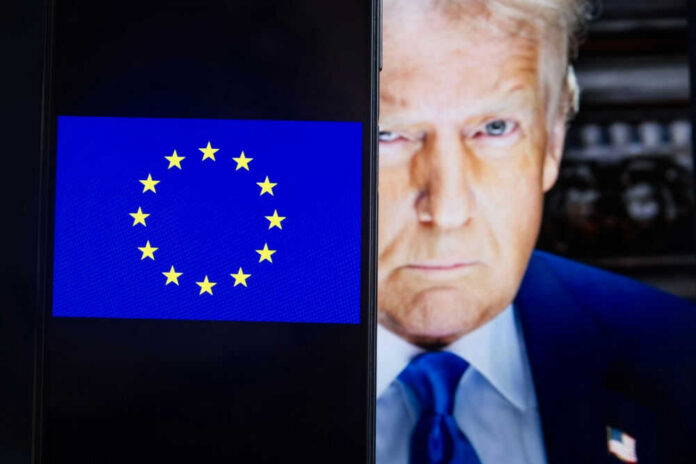
President Trump’s urgent demands for European warships to reopen the Strait of Hormuz have been flatly rejected by EU leaders, leaving America to confront Iran’s blockade alone and exposing decades of freeloading by ungrateful allies.
Story Snapshot
- EU foreign ministers in Brussels unanimously reject Trump’s calls for military deployments, prioritizing diplomacy over U.S.-led war efforts.
- Strait of Hormuz traffic nears zero due to Iranian missiles and drones, threatening 20% of global oil and critical fertilizer supplies.
- UK’s Keir Starmer and Germany’s leaders declare the conflict “not our war,” refusing to risk troops amid Ukraine commitments.
- Transatlantic rift widens as Trump criticizes allies’ lack of enthusiasm, demanding burden-sharing from NATO partners long protected by America.
Timeline of the Crisis
U.S. and Israel launched military strikes against Iran, excluding European allies from planning. Iran retaliated with missile and drone fire, halting nearly all traffic through the Strait of Hormuz. President Trump then issued repeated demands for European warships to force the strait open.
On March 16, 2026, UK Prime Minister Keir Starmer stated Britain would not join a wider war but seek a collective navigation plan. German officials demanded clarity on U.S. aims while emphasizing the fight is not theirs.
EU’s Firm Rejection
On March 17, 2026, EU foreign policy chief Kaja Kallas rejected any military expansion to the strait. EU foreign ministers met in Brussels and declined to commit ships or expand Operation Aspides from the Red Sea.
Kallas stated nobody is ready to put personnel in harm’s way and called for a UN truce to allow shipments. Germany’s Foreign Minister Johann Wadephul and Defense Minister Boris Pistorius echoed “Nein/non/no” to force-opening the strait, questioning the efficacy of a handful of frigates.
The European Union — the 27 nation bloc that includes some of America's closest allies — made it clear Tuesday that it would not be racing to meet President Trump's calls for military assistance to reopen the Strait of Hormuz.https://t.co/l4fuK363ft
— WJZ | CBS Baltimore (@wjz) March 17, 2026
Stakeholders and Motivations
President Trump seeks burden-sharing from allies protected by U.S. defense spending for decades. Europe prioritizes its resources for Ukraine aid, self-defense, and economic stability to avert energy, food, and fertilizer crises. UK’s Starmer focuses on protecting British interests without wider war involvement.
France and Luxembourg express vague willingness only after fighting subsides. EU’s 27 nations and overlapping NATO members leverage unity to resist U.S. pressure after exclusion from Iran war planning.
NATO ambassadors scheduled a March 18 meeting for situational awareness, remaining non-committal. No European ships are pledged, with focus on protecting their own bases and civilians. Trump noted varying levels of ally enthusiasm, highlighting frustrations with reluctant partners amid America’s sacrifices.
Economic and Strategic Impacts
The strait handles 20% of global crude oil and key gas and fertilizer shipments. Closure spikes energy prices, disrupts markets, and risks shortages worldwide, hitting American families already burdened by past inflation. Long-term, this erodes NATO cohesion, boosts Iran’s leverage, and shifts Europe toward diplomacy over military resolve.
Perceived European weakness may embolden adversaries, prolonging the conflict if allies withhold support America has long provided.
Journalists note Europe’s universal refusal risks delaying U.S. goals, with Ukraine diverting resources. Pro-U.S. views argue allies owe support after years of protection; Europeans claim lack of consultation justifies prioritization of their crises.
This transatlantic tension underscores the need for allies to step up, aligning with conservative calls for fair burden-sharing and strong American leadership.
Sources:
European Union rejects Trump’s calls for military deployments to reopen Strait of Hormuz
EU rejects Trump’s request to help secure the Strait of Hormuz
European allies tell Trump ‘nein, non and no’ on help to force open Hormuz Strait
EU rejects Trump’s request to help secure the Strait of Hormuz
Newsletter: Europe resists US pressure to force re-opening of Strait of Hormuz