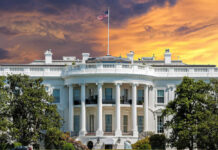


President Trump scores a major legal victory as a federal judge rejects leftist activists’ attempt to halt construction of a new White House ballroom, though the ruling comes with temporary restrictions that demonstrate how bureaucratic red tape continues to hamper executive authority.
Story Highlights
- Federal judge denies National Trust for Historic Preservation’s request to block White House ballroom construction
- Trump administration must submit plans to National Capital Planning Commission by end of 2025
- Two-week restriction on below-ground construction while bureaucratic processes proceed
- $400 million donor-funded project expected to complete by summer 2028
Judge Rejects Preservation Group’s Obstruction Tactics
U.S. District Judge Richard J. Leon delivered a decisive blow to liberal obstructionists on Tuesday, denying the National Trust for Historic Preservation’s motion to temporarily halt President Trump’s White House ballroom construction project.
The judge ruled that the nonprofit failed to establish sufficient irreparable harm to justify stopping the entire project.
However, Leon imposed a two-week moratorium on below-ground structural work, requiring the Trump administration to submit construction plans to the National Capital Planning Commission by year’s end before proceeding with foundational elements.
Federal judge denies request to temporarily block construction of White House ballroom; says WH must file ballroom plans with @NCPCgov by year's end w/ @JakeMRosen and @kathrynw5 https://t.co/jBqBHgghdQ
— Arden Farhi (@ArdenFarhi) December 16, 2025
Activists Challenge Executive Authority Over White House Renovations
The National Trust for Historic Preservation launched what represents the first major lawsuit against Trump’s second administration, claiming the president lacks authority to renovate White House facilities without extensive public review processes.
The group’s legal strategy centers on allegations that five federal laws were violated during demolition and construction phases, particularly targeting the administration’s environmental impact statement as “woefully inadequate.”
Their lawsuit fundamentally challenges presidential prerogatives over executive residence management, reflecting broader leftist efforts to constrain executive power through judicial activism.
Trump Administration Defends Executive Prerogatives
Justice Department attorney Adam Gustafson mounted a robust defense of executive authority, arguing that federal courts possess limited jurisdiction over presidential actions regarding White House operations.
The government maintains no legal obligation exists to file demolition or below-ground construction plans with the National Capital Planning Commission. Officials emphasize that since no final ballroom design has been approved, accusations of law violations remain premature.
The administration’s position reflects constitutional principles supporting executive independence in managing official residences and ceremonial spaces.
Project Details and Political Implications
Trump’s donor-funded ballroom project carries an estimated cost between $300-400 million, with completion scheduled for summer 2028 near the end of his presidential term. The National Park Service oversees construction while much of the East Wing undergoes demolition to accommodate the new facility.
Trump celebrated Tuesday’s ruling, expressing frustration with legal challenges against infrastructure improvements that previous administrations have long sought. The case highlights ongoing tensions between conservative governance priorities and progressive attempts to weaponize bureaucratic processes against Republican leadership.
Upcoming Legal Proceedings
A preliminary injunction hearing scheduled for January’s second week will determine whether additional construction restrictions apply during the legal dispute’s resolution.
The Trump administration has committed to consulting with the Commission of Fine Arts, though Trump’s removal of most commission members has eliminated the quorum necessary for formal proceedings.
This bureaucratic situation exemplifies how administrative state obstacles continue hampering efficient government operations, forcing the president to navigate unnecessary regulatory hurdles while pursuing legitimate infrastructure improvements for America’s most important governmental facility.