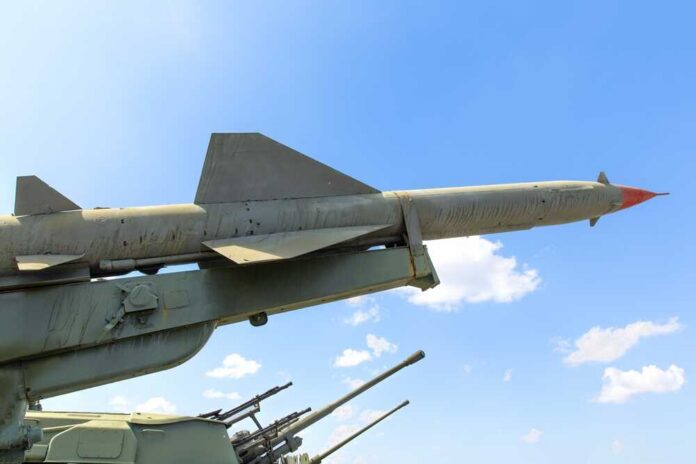
The Iran war did not just test American missiles in combat; it exposed how close the United States is willing to run its arsenal to empty in a dangerous world.
Story Snapshot
- The United States used about half of some key long-range missiles during the Iran war, including Precision Strike Missiles.
- Analysts say rebuilding stocks of these high-end weapons will take years, not months, even with more money.
- Heavy missile use against Iran raises hard questions about readiness for China, Russia, or a second crisis.
- American industry and strategy now face a simple choice: slow down wars or speed up production.
Missile stockpiles pushed to their limits in the Iran war
U.S. forces went to war with Iran knowing long-range precision missiles were scarce, and used them anyway. A leading security think tank found the United States expended at least forty five percent of its Precision Strike Missiles during the campaign, a system meant to give the Army deep strike reach across the modern battlefield.
That burn rate alone would alarm planners, but it sat inside a larger picture of heavy use of Patriot interceptors, Terminal High Altitude Area Defense batteries, Joint Air-to-Surface Standoff Missiles, and Tomahawk cruise missiles.
U.S. has used 'virtually all' of its long-range precision missiles during Iran war: Reuters https://t.co/Hdd5oEHHXO
— CNBC (@CNBC) August 4, 2026
In the first weeks of fighting, estimates say American forces fired more than six thousand offensive and defensive munitions, including nearly forty six percent of Army Tactical Missile System missiles and Precision Strike Missiles and almost forty percent of U.S.-operated Terminal High Altitude Area Defense interceptors. That is not a minor dent.
Analysts at the Center for Strategic and International Studies warned that for four major missile types, the United States may have used more than half of prewar stocks before a ceasefire even took hold. The Pentagon began expanding production, but experts said deliveries could still take years.
Precision Strike Missile and Army long-range fire power
Precision Strike Missile matters because it sits at the core of the U.S. Army’s long-range precision fires plan. The missile replaces older Army Tactical Missile System rounds and is designed to hit targets at ranges that used to belong only to air or naval forces. Before the Iran war, the Army’s inventory was small because the missile had only just entered production.
During the conflict, at least one Army unit reportedly expended every new Precision Strike Missile it had at the start of the war, showing how quickly a fresh capability can be drained in real combat.
Defense analysts say Precision Strike Missile and Joint Air-to-Surface Standoff Missile will take several months to a year to replace to prewar levels. That estimate sounds short until you remember those are only two missile families.
The same analysis warns that land attack cruise missiles, Terminal High Altitude Area Defense, and Patriot interceptors will take three or more years to rebuild, while Standard Missile 3 and Standard Missile 6 naval air-defense missiles will take about two years.
For a country that might face overlapping crises, that time gap between use and replacement matters more than any single launch count.
Industrial base strain and the risk of the next war
Senior officials and outside experts now admit the simple truth: U.S. industry cannot quickly replace the missiles fired in the Iran campaign if another major war breaks out soon.
According to reporting based on internal Defense Department assessments, the military has significantly depleted key missile stockpiles and created a “near-term risk” of running low on ammunition in a future conflict within the next few years.
Some analysts warn that if the United States had to fight a high-end war in the Indo-Pacific at the same time, the shortage could bite hard.
A sovereign nation that spends trillions on defense should not discover in the middle of a regional war that it has less than a month’s worth of some missile types on hand.
American taxpayers expect deterrence backed by real capacity, not by a hope that no one else starts trouble while the factories catch up. When a campaign lasting just weeks can burn through roughly half of Patriot interceptors, as one analysis suggests, the system looks tuned for peace, not for sustained conflict.
Strategic warning for a distracted republic
Think tanks and commentators have started calling this moment a strategic red flag, arguing that America is “running on empty” in its weapons stocks after the Iran war.
Their message is not that U.S. forces lost the fight, but that victory came with a hidden bill: years of rebuilding missile inventories at the very time rivals like China and Russia are testing American will. A detailed review of the campaign notes that rebuilding seven core munitions to prewar levels will take between one and four years, depending on the weapon.
The warning cuts two ways. On one side, it proves that President Trump’s team was willing to unleash real power to stop Iran’s aggression, rather than fight a half-hearted war.
On the other, it shows how years of comfort with slow, complex procurement left the arsenal thin when it finally mattered. The lesson is not to avoid using missiles, but to build a defense industrial base that can surge fast enough that no enemy counts on American stockpiles running dry.
Sources:
youtube.com, chosun.com, businessinsider.com, csis.org, cnn.com, congress.gov, americanmind.org, facebook.com, cronkitenews.azpbs.org, foxnews.com, reddit.com