Washington just secured permanent access and new build rights in Greenland, locking the Arctic front door.
Story Snapshot
- United States, Denmark, and Greenland announced a security agreement expanding U.S. military access and rights.
- The deal grants permanent access, basing, and overflight rights, with new construction authority reported.
- Leaders in Copenhagen and Nuuk affirmed Greenland’s sovereignty and self-determination remain intact.
- The agreement bars adversary bases and screens sensitive foreign investment in Greenland.
What The Agreement Does, In Plain Terms
Officials from the United States, Denmark, and Greenland said they reached a deal to expand U.S. military rights on the island. The pact grants U.S. forces permanent access, basing, and overflight rights, according to a United States State Department official.
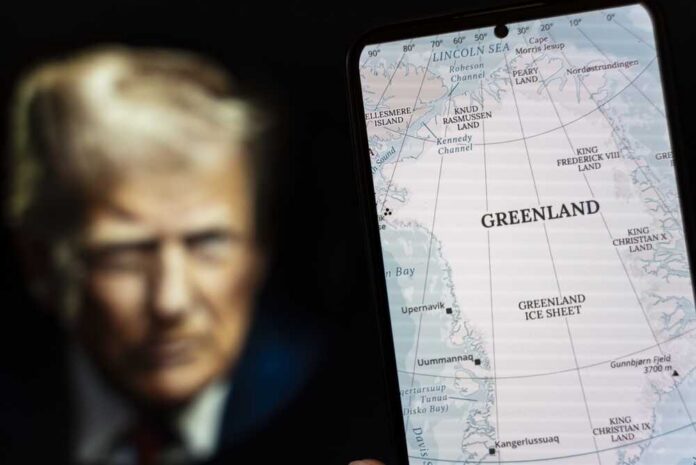
President Trump announced the agreement and framed it as securing permanent control of Greenland’s security. The package also includes steps to block bases by non-North Atlantic Treaty Organization countries and limit risky investments linked to adversaries.
Reporting says the United States can build new military structures in Greenland without requiring approval from Denmark or Greenland. That would remove years of friction over permissions and timelines for Arctic projects. The practical outcome is speed.
Sensors, runways, fuel hubs, and housing can go from idea to action before the ice melts and the season closes. That pace matters for missile warning, space tracking, and resupply across the North Atlantic bridge.
Sovereignty Stays With Greenland And Denmark
Danish Prime Minister Mette Frederiksen and Greenlandic Prime Minister Jens-Frederik Nielsen backed the arrangement in public statements. They said Greenland’s sovereignty and the Greenlandic people’s right to self-determination remain in full force. Their message is clear.
The United States can defend, deter, and build, but it does not own Greenland. That line threads a needle between stronger defense and local control over land and law.
US to open two Cold War-era military bases in Greenland as Trump celebrates landmark deal for 'permanent control' over security of territory https://t.co/wwAnOoEpsA
— Daily Mail (@DailyMail) September 22, 2026
That balance fits a long pattern. The United States has maintained forces in Greenland since World War II. A 1951 defense agreement, later amended, structured access and operations for decades. At Cold War highs, 17 American facilities stood on the island.
Later drawdowns cut the footprint to the core site at Pituffik Space Base. Today’s deal updates the framework for a sharper era of great power rivalry without changing who holds the flag on the ground.
Why Greenland Matters Right Now
Greenland sits along the shortest great-circle routes between North America and Europe. It straddles the path of long-range bombers, ballistic missiles, and hypersonic glide vehicles. It anchors space warning radars that track threats rising over the pole.
As the Arctic warms, sea lanes open longer each year. That raises traffic, risk, and chances for mischief. Permanent access and build rights let planners build a faster, tougher shield over the High North.
The deal also slams the door on rival footholds. It prohibits bases by countries outside the North Atlantic Treaty Organization and screens sensitive foreign investments. That aims straight at China’s state-backed firms and Russia’s Arctic push.
Blocking risky ports, airfields, and dual-use mines in Greenland removes leverage points near North America. It keeps critical lanes and sensors out of hostile hands and limits gray-zone pressure in a fragile theater.
What Changes Next On The Ground
Two Cold War-era locations are slated for renewed U.S. use alongside Pituffik, according to public reporting. Expect rapid work on weather-hardened infrastructure, fuel, housing, and airfield upgrades once procedures clear.
Look for more joint drills, prepositioned gear, and space-domain integrations. The focus will be early warning, anti-submarine patrol loops, and resilient communications across the polar cap. Early activity will likely cluster on sites with intact runways and proven logistics lanes.
US President Donald Trump is moving from his earlier ambition of acquiring Greenland to a security arrangement that would significantly expand the US military footprint on the Arctic island.
Here's what the deal is about 👇https://t.co/ru1c5Qc3CX
— Mint (@livemint) September 22, 2026
Denmark said the agreement would be signed during the United Nations General Assembly window and follow its normal parliamentary steps. Greenland’s lawmakers will also engage. Those steps do not change the direction of travel. Allies agreed on the strategic core, and leaders endorsed the outcome.
The policy arc is set: lock the Arctic flank, speed construction, and keep adversaries off the island. That is a hard-nosed shield for North American defense in a sharper world.
Sources:
nypost.com, nbcnews.com, aljazeera.com, npr.org, politico.com, reuters.com, euronews.com, goodmorningamerica.com