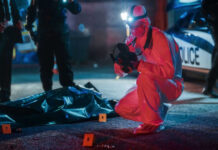
A routine teen “meet-up” at a neighborhood park turned into a gunfight that left two families planning funerals before lunchtime.
Quick Take
- Police say two juveniles agreed to meet at Leinbach Park in Winston-Salem for a planned fight before 10 a.m. on April 20, 2026.
- Gunfire erupted during the confrontation, and investigators say multiple people exchanged shots.
- Two teens, ages 16 and 17, died; five others ages 14 to 19 suffered injuries ranging from minor to critical.
- Investigators cautioned that some of the injured may also have been involved in the shooting, complicating the case.
How a “Planned Fight” Became a Morning Shootout
Winston-Salem police described the start in plain terms: juveniles arranged a fight at Leinbach Park, a public space in a residential area near a middle school. The timing matters.
Before 10 a.m. on a weekday, the expectation is dog-walkers and school traffic, not a crossfire scene with victims found inside the park and in nearby parking lots. That contrast is the story’s gut punch.
Police say a firearm discharged during the fight, then the situation “escalated significantly” into multiple people exchanging gunfire. That phrasing signals a chaotic chain reaction rather than a single trigger-pull.
It also hints at preparation: the leap from fists to bullets usually means at least one participant arrived armed and others either did too or gained access quickly. Investigators have not yet said how many guns were involved.
The Victims, the Ages, and the Brutal Math of Youth Violence
Two teenagers died: 17-year-old Erubey Romero Medina, found in a parking lot, and 16-year-old Daniel Jimenez Millian, found inside the park, according to reporting that cited law enforcement and state investigators.
Five more were injured, including four female teens (14, 15, 17, 19) and an 18-year-old male. Those ages aren’t a detail; they’re an indictment of how quickly adulthood arrives when weapons show up.
2 killed, 5 injured as planned fight between teens turns into deadly shooting at North Carolina park: https://t.co/zlCcI5eQQr
— The Virginian-Pilot (@virginianpilot) April 20, 2026
Police also said they believed some of the injured may have been involved in the shooting. That overlap—victim and suspect in the same body—makes these cases harder to solve and harder for the public to process.
People want clean categories: innocent bystander, guilty shooter. Real life, especially among groups of teens, can look more like mutual combat with tragic consequences, where bravado, fear, and poor judgment collide at once.
Why Proximity to a School Changes the Stakes
Leinbach Park sits near a middle school, and authorities emphasized that students were safe and the incident remained isolated to the park. That reassurance matters, but it shouldn’t lull anyone into thinking “isolated” means “rare.”
Parks and school-adjacent spaces function as staging grounds because they feel familiar, public, and easy to access. The grim lesson for parents is that the boundary between “school zone” and “street” has become thinner than it used to be.
For readers who grew up settling disputes with words, a scuffle, or a cooling-off period, the part that sticks is the speed of escalation. A planned fight already signals intent to humiliate or dominate, often in front of peers.
Add phones, social pressure, and the modern instinct to “show up” rather than “walk away,” and the scene becomes a performance. When guns enter a performance, the audience becomes collateral.
No Arrests, Multiple Shooters, and the Hard Work of Sorting Roles
As of the initial reporting, police said no one was in custody, and detectives were still determining each person’s role. Multiple shooters changes everything: witness accounts conflict, shell casings spread, and people scatter.
Investigators must separate who fired, who carried, who provoked, and who tried to flee. That process takes time, and it frustrates the public, but rushing it can produce the kind of mistakes that let the wrong people walk.
American common sense says consequences matter: if you bring a gun to a fight, you own what follows. The complication comes when authorities suspect some injured participants also fired shots.
The rule should stay simple even when the facts are messy: self-inflicted chaos doesn’t become less deadly because the perpetrators also got hurt. Accountability still applies, and it should apply evenly.
The Real Warning Sign Parents Miss Until It’s Too Late
The most predictive detail in this incident isn’t the weapon or the location; it’s the phrase “agreed to meet.” That suggests planning, coordination, and a social circle that knew what was coming. When teens schedule conflict, adults tend to hear “drama” and assume it will burn out.
That’s yesterday’s logic. Today, scheduled conflict can mean someone is recruiting backup, filming for status, or bringing protection “just in case.”
Community leaders often reach for broad slogans after shootings, but the practical response starts smaller and sooner. Parents should treat sudden secrecy, new “friends,” and unexplainable changes in routine as actionable, not merely moody.
Schools and police can’t parent from a podium, and parks can’t be policed into perfection. A culture that normalizes walking away from provocation—without losing face—is still the cheapest violence-prevention program ever invented.
2 Killed, 5 Injured as Planned Fight Between Teens Turns into Deadly Shooting at North Carolina Park https://t.co/dDcmeX2tU2
— Headline USA (@HeadlineUSA) April 22, 2026
Winston-Salem now waits for what investigators can prove: who fired, how many guns appeared, and whether the shooters were the same people who showed up expecting a fistfight. Until those answers land, the only certainty is the one families already know—two teens will never grow older, and five more will carry April 20, 2026 for the rest of their lives.
Sources:
2 teens dead, 5 injured after planned fight turns into a shootout at Winston-Salem park
2 dead after gunfire breaks out during planned fight among juveniles: Police