

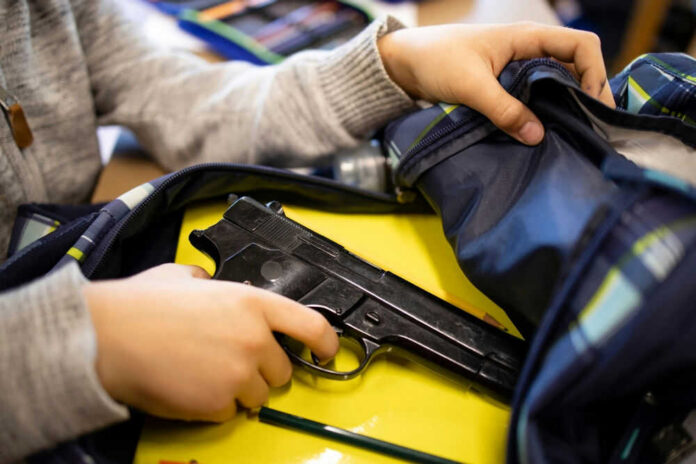
A 16-year-old used a pump shotgun his mother reportedly bought him for his birthday to attack his former Oregon elementary school, and the fight now turns to who, if anyone, should be held legally responsible.
Story Snapshot
- Law enforcement sources say the shooter’s mother bought the shotgun as a birthday gift.
- Oregon law limits minors’ firearm possession, with parent-transfer exceptions for some long guns.
- Police described a planned assault with up to 15 shots fired and extra shells recovered.
- A victim’s family launched a probe into how the teen got the gun and entered the school.
What police say happened and why it matters
Officials identified the gun as a Maverick 88 pump-action 12-gauge shotgun reportedly bought by the teen’s mother, Shauntai Nickerson, around his birthday and given for recreation, according to named outlets citing senior law enforcement sources. Police said the shooter fired at a vehicle, tossed the gun over a fence, breached a locked door, and fired as many as 15 rounds inside the school. Investigators reported dozens of additional shells recovered near the weapon, signaling preparation and intent.
The report that the gun was a birthday gift is central because it links the adult purchaser to the teen’s access. That single detail drives public anger and legal interest. But it does not, by itself, prove a crime. Ownership records, storage facts, and evidence of warning signs will decide liability, not headlines. Prosecutors tend to act when the facts show clear neglect, not when tragedy and outrage run hot.
What Oregon law allows, and where lines are drawn
Oregon generally bars people under 18 from possessing firearms. The law allows narrow exceptions, including parent transfer or supervised use for hunting or target practice with some long guns. That means a parent can lawfully introduce a mature teen to a shotgun for sport. A criminal-defense lawyer told reporters that giving a 16-year-old a shotgun is common and not, by itself, a legal violation. That view matches the statute’s design and the state’s hunting culture.
The legal question shifts when access is unsupervised, storage is lax, or warning signs are ignored. Prosecutors must show the adult knew, or should have known, about a serious and unjustifiable risk and still allowed access. That standard fits American conservative values: specific fault, not collective blame; personal responsibility proven by evidence, not assumed by emotion. If storage was secure and there were no red flags, prosecutors will struggle to sustain charges.
Gaps in the public record that will decide accountability
Reporters have not seen a public receipt or affidavit describing the exact transfer, storage method, or how the teen got shells. The mother reportedly cooperated with police and said she saw no warning signs. She also described her son as a good boy. Those claims do not settle the matter, but they underscore the need for hard proof, not guesswork.
Key items will settle the core questions: the store’s transaction records, the Bureau of Alcohol, Tobacco, Firearms and Explosives trace, the search-warrant inventory, any photos showing storage devices, and interviews with family and friends. If investigators find a cable lock, a safe, or controlled ammo storage, the case looks one way. If they find a loaded shotgun behind a closet door, it looks very different.
The victim family’s push, the community’s pressure, and prudence
Counsel for a victim’s family launched an independent probe into who contributed to the violence, including how the shooter got the weapon and entered the school. Civil discovery can surface what a criminal inquiry might take months to confirm. Families will look for texts, range photos, and any sign of prior threats. They will also look beyond the home, toward school entry controls, response time, and campus hardening that might have slowed or stopped the attack.
**A father with a .40 and a teacher with her phone turned what could have been a longer slaughter at Silver Rail Elementary into four student-and-staff deaths on October 15.**[[1]](https://t.co/M6uH2bGTG1)
[Take 14/15 · 𝕏-4]
### 1. The Frame
**What people think this is about:**…— GrumpyNews, emotionally clean news. (@GrumpyNews_) October 17, 2026
Law enforcement credited a locked door, a quick-acting teacher, and an armed passerby with limiting the carnage. That combination aligns with common-sense layered defense: deny entry, disrupt momentum, and end the threat fast. Many readers will take a lesson from this. Responsible gun ownership means locking guns and storing ammo safely at home. Responsible public safety means clear school security and trained, capable responders who act in minutes, not hours.
Bottom line: evidence first, then judgment
Three truths can stand together. First, a mother can legally buy a shotgun and teach a teen to use it. Second, a teen can betray that trust in a way no parent expects. Third, if the adult ignored warning signs or left a deadly tool open to misuse, the law can and should hold that adult to account. The difference lies in facts that juries can see and touch, not in viral phrases or grief alone.
Sources:
cbsnews.com, cnn.com, nbcnews.com, cbs58.com, en.wikipedia.org