
A midday argument on a Midtown subway platform ended with one shot to the chest and a young man dead.
Story Snapshot
- Police say a dispute preceded the shooting on the northbound E platform at 12:21 p.m.
- The victim, 26-year-old Darrel Rodriguez, was shot once and died at the hospital.
- Investigators called it targeted, not random, and released a suspect description.
- The shooter fled; no arrest had been announced at the time of reporting.
What Police Say Happened On The Platform
New York City Police Department detectives reported that a man approached Darrel Rodriguez on the northbound E train platform and shot him once in the chest, then ran from the station around 12:21 p.m. The station sits at 53rd Street and Seventh Avenue in Midtown Manhattan. Medics rushed Rodriguez to a hospital, where he died. Police said the shooting followed a dispute and was not random. That claim focused the search for a specific suspect rather than a roaming threat.
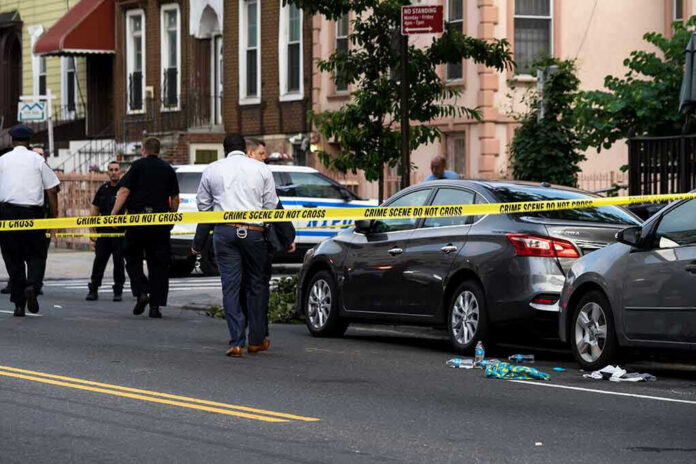
Investigators said the confrontation moved from the platform into a subway car and then back to the platform before the gunfire. Reporters at the scene described police taping off the area and collecting video from transit cameras. The New York Times cited a law-enforcement official who said the men had argued but did not say why. That detail matters for public fear. A random attack means anyone could be next. A targeted fight suggests a conflict, then a deadly choice.
A Name, A Timeline, And A Manhunt
Officials identified the victim as 26-year-old Darrel Rodriguez. Police asked for tips and warned that the gunman remained at large. Reporters described added patrols at the station and nearby stops as riders moved through the evening rush. Police shared a concrete suspect description, including red clothing, a black vest, and a face covering. Detectives worked the usual threads: video, witness accounts, shell casings, and entry points. The hunt aimed to lock down the shooter’s path and potential ties.
Officers and transit staff checked platforms and cars for more evidence while canvassing for riders who saw the argument. The agency’s camera network likely caught parts of the heat-up and flight, even if one angle missed the exact shot. That is how most subway cases break. You build a map of movement, then match clothing, gait, and timing across cameras. When that aligns with witness reminders—“the vest,” “the mask,” “the red”—you close the circle and make an arrest.
Why Classification Matters For Riders And Policy
Newsrooms and officials often split subway violence into two buckets: random danger versus an argument in public. That line shapes both fear and policy. The police description here labels the case as targeted. That narrows the risk picture for daily riders and concentrates enforcement on the suspect’s network. Crime research also warns that transit crime counts vary across agencies and are often underreported, which can skew how safe riders feel versus what police logs show. Good data helps real fixes.
Midtown subway shooting — Man killed inside 53rd St 7th Ave station — B D E lines — E train pulled up moments before — Two pops eight seconds apart — Witness: gentleman in blazer laying — Bystanders did CPR held hand — Suspect fled red tracksuit — NYPD searching — 7th transit… pic.twitter.com/6LyBUEHxmS
— RandomStuff A2Z (@RandomstuffA2Z) October 17, 2026
Policy talk followed this shooting fast. Some transit advocates called for new limits on face coverings in stations, arguing masks make it harder to identify violent offenders. Others pointed to more patrols and visible enforcement during peak hours. A common-sense frame urges both: more cops where crowds are thick and a clear plan to track and stop repeat offenders. When police call an attack targeted, the next step is swift arrest, clear charges, and a signal that the system still has teeth.
Sources:
nbcnews.com, nytimes.com, nbcnewyork.com, abc7ny.com, ny1.com, nydailynews.com, cbsnews.com, academiccommons.columbia.edu